Wednesday, May 27, 2020

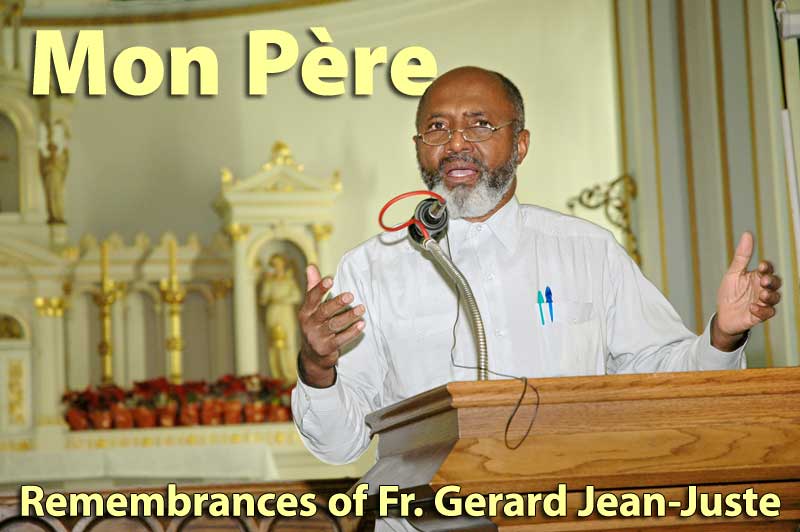
Mon Père, Remembrances of Fr. Gerard Jean-Juste in Haiti (May 29, 2009)

Originally Published May 29, 2009


Mon Père, Remembrances of Fr. Gerard Jean-Juste in Haiti

by Kevin Pina

I called Fr. Gerard Jean-Juste 'my father' as did so many others who worked with him and loved him for his courage, commitment and generosity. I first met this incredible man after the first coup against Aristide in 1991. Another Catholic liberation theology priest, Fr. Jean-Marie Vincent, introduced him to me. I had returned to Haiti to continue filming for my documentary Haiti: Harvest of Hope.

When I returned to Haiti Fr. Vincent told me that there was another priest assigned to the parish of St. Gerard in the capital of Port au Prince who was protecting and hiding those targeted by the military repression. At great personal risk and never asking anything in return, Fr. Jean-Juste developed an underground network of non-violent resistance to the military and police repression. His network would later expand to include opposition to the paramilitary forces created by the CIA such as the Front for Advancement and Progress in Haiti or FRAPH.

Fr. Jean-Juste was always clear in his intention. To console me after the assassination of Fr. Vincent in Aug. 1994 he said, "There is no such thing as a safe harbor against such brutality except in your own conscience. No matter how hard they try to kill the thirst of the majority of the poor for a better life in Haiti, their brutality and tactics only provide more water for our struggle. We must never let them set the terms for the liberation of the majority of the poor in Haiti with their acts of violence. We must always stay focused on the goal."

After Aristide's return to Haiti in 1994, Fr. Jean-Juste remained an anchor for the Lavalas movement that he believed represented the interests of the poor majority until his death this last Wednesday in a Miami hospital. For this conviction he would suffer dearly especially after accepting an assignment to St. Clare's church in the neighborhood of Ti Place Cazeau in Haiti's capital. Once there, he would continue to not only preach on behalf of the rights of Haiti's poor majority but would also put his faith into practice by creating community empowerment projects. These included literacy and economic programs providing the poor with opportunities to lift themselves out of poverty and a daily canteen that made hot meals available to the most vulnerable in the community. It was not uncommon to find him singing while serving meals to poor children, who he adored and honored as the future of Haiti, on any given afternoon at St. Clare's.

Following the second coup against Aristide in 2004, he lost his weekly radio program at Radio Ginen after anonymous threats against the station. He would never blame the owner of the station telling me, "I understand the forces of repression and the lies they tell have taken control of Haiti for the moment. They are trying to convince the world that our beautiful movement of the poor is ugly and desolate. Aristide was kidnapped after the elite cut a deal with the Bush administration and this much is clear, the repression against Lavalas has started again."

Fr. Jean-Juste would continue to preach that Lavalas was a beautiful movement of the poor while most of the world fell prey to a systematic campaign to label and isolate it as a violent aberration. He would use every opportunity to condemn the second ouster of Aristide as a "coup-napping" that relied upon the brutal force of the former military and death squads who had invaded Haiti from the Dominican Republic in early February 2004. Fr. Jean-Juste described the situation as, "The Bush administration hiding behind the pretext of death squads and the military to justify kidnapping our democratically elected president." This insistence earned him the love and respect of Haiti's poor majority along with regular condemnation and death threats from supporters of the coup.

Fr. Jean-Juste along with many others considered September 30, 2004 a true test and turning point for the Lavalas movement in Haiti. The Haitian police opened fired on unarmed protestors during a demonstration on the thirteenth anniversary of the first military coup against Aristide. The slaughter would be justified by Jean-Claude Bajeux, a so-called human rights advocate and leader of a ‘civil society organization' called the Group 184 that worked for Aristide's ouster. Bajeux claimed that Lavalas partisans had emulated terrorists in Iraq and beheaded police officers earlier in the day. The Latortue regime ran with it and borrowed Bajeaux's unfounded assertion that it was part of a terror campaign by Lavalas called "Operation Baghdad." The international community, already compromised and cajoled by the Bush administration, stood poised and ready to accept any explanation that provided a counter argument to the massive demonstrations in the streets calling for Aristide's return. The demonstrations were proving an embarrassing reminder that the so-called opposition to Aristide was really a minority and that he never lost the support of the masses of the Haitian people as they had claimed.

Associating Lavalas with terrorists in Iraq was a marketable product in the international press that would not only distract from the growing demonstrations but also serve to justify the increasing repression. In actuality, it was a continuation of the strategy the Bush administration had employed against the popular Haitian folksinger Annette Auguste in May 2004 justifying her arrest by claiming she was organizing with Muslims in a local mosque to attack U.S. Marines in Haiti.

Attempts by the Latortue regime and the international community to label Lavalas as a terrorist organization with Operation Baghdad were always ludicrous. Fr. Jean-Juste with his usual clarity would state, "Bush and the Organization of American States are trying to equate the resistance against the coup by the poor with Al-Qaida and Iraqi terrorists. The OAS is bought off and a disgrace to the memory of Haiti having helped Bolivar for the emancipation of Latin America. They along with the U.S., France and Canada are siding with the elite in Haiti who would rather use this foreign label to brand the Lavalas movement as terrorists than accept their own responsibility for having driven this country into the ground with their own greed."

The Latortue regime and its allies believed that Operation Baghdad had finally provided them with the excuse they needed to destroy Lavalas and repress its most vocal supporters. High on the list was Fr. Jean-Juste. After Sept. 30, I heard several radio interviews with Haitian police spokesperson Jesse Coicou accusing unnamed priests of harboring and assisting gunmen involved in Operation Baghdad. I knew whom they meant and called Fr. Jean-Juste to make sure he was safe. He seemed unconcerned and reminded me that part of their goal was to frighten any one who opposed the coup into silence. He finished with "It is in God's hands and we have to keep talking about what's really going on here. We have to keep doing our work."

On October 13, 2004 the UN allowed the former brutal military to ‘officially' enter the capital of Port-au-Prince unchallenged. As they paraded through the streets waving automatic weapons and promising to kill ‘Lavalas bandits,' Fr. Jean-Juste was serving meals to the children at St. Claire's parish. As the children ate, heavily armed police wearing black ski masks surrounded the church before entering the premises with their guns drawn. As the children watched in terror they brutalized Fr. Jean-Juste before dragging him out and throwing him into the back of a waiting police car.
Fr. Jean-Juste's arrest came in the midst of a campaign of unprecedented slaughter and mass arrests throughout Oct. and Nov. 2004. It was clearly meant to silence his criticism of what he considered crimes against humanity being committed by the Haitian police against poor communities in the capital. The repression and his arrest were justified by Operation Baghdad, as the Latin American countries in charge of the UN military mission, namely Brazil, Chile and Argentina, remained silent and continued to provide support to the Haitian National Police.

Despite the reality that no warrant was ever produced nor any evidence linking Fr. Jean-Juste to a crime ever presented, he was held in prison for more than six weeks. He was finally released under the cover of darkness at 2 o'clock in the morning on Nov. 29 to avoid the spectacle of thousands of Lavalas supporters gathering to celebrate the news. I called him later in the day to express my joy and arrange another interview. All he would say was "Kev, get over here. We can't start the party without you."

Fr. Jean-Juste began giving interviews right after his release in which he condemned the U.S., France and Canada for their role in the coup and the UN for backing the repression against the Lavalas movement. He declared that Latortue was leading a ‘regime of terror' and chastised the UN for their "despicable role in providing support to the Haitian police as they unjustly murder and jail thousands for their political convictions." It was statements like these and his popularity among the poor that made him an even larger target for the Latortue regime. All they needed was the right circumstances and a new pretext for hauling him back to prison. Fr. Jean-Juste knew this but refused to remain silent.


©2009 Kevin Pina

Saturday, March 2, 2019

Haiti: "The people do not buy liberty and democracy at the market" - Aristide

Haiti: "The people do not buy liberty and democracy at the market"

by Kevin Pina

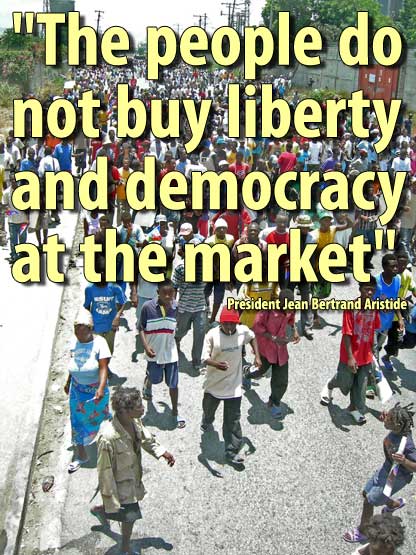
July 15, 2006 - Thousands supporting the Fanmi Lavalas political organization stream out of the poor neighborhoods of Cite Soley to join thousands more from other neighborhoods in Port au Prince to celebrate President Aristide's birthday ©2006 HIP/Lovinsky Pierre-Antione

Lavalas represents the majority political movement opposed to the neo-liberal economic model of development unfolding in Haiti today. Lavalas is the majority of Haitians without question who oppose the International Monetary Fund (IMF), the World Bank (WB) and the Inter-American Development Bank,(IADB)  project for "structural adjustment including eliminating import and export tariffs, selling off State-owned industries and businesses, a low minimum wage and an obsessive reliance on the private sector as the motor for economic development". Haiti's grassroots movement has named it "The Death Plan for Haiti" .

The major obstacle to the plan of the International Financial Institutions (IFIs) for the people of Haiti was democracy itself in the form of the Lavalas movement representing the interests of the majority of the poor, and their twice elected president, Jean Bertrand Aristide. He has been and currently is the symbol of resistance in the formation of the Lavalas movement for change in Haiti. Aristide's government refused to privatize key industries like the Telephone Company (Teleco) and the Electrical company (EDH) to accommodate the IFIs insistence social programs for all Haitian government programs be cut. The Fanmi Lavalas party would take profits from these same State-owned businesses and invest in a universal literacy and food program to provide millions of the poor with subsidized meals. For the first time in history Haiti had a safety net in place to insure against widespread hunger and malnutrition. Over the objections of the IFIs and Haiti's predatory economic elite, the minimum wage was doubled twice during Aristide's first and second terms raising wages for the lowest paid work force in the hemisphere. Not so coincidentally, both of Aristide's terms were cut short twice by a coup.

It should be abundantly clear to even the most casual observer by now that Aristide's social program was a major factor in the coup of Feb. 2004. It not only resulted in the ouster of the the democratically elected president but also eliminated more than 7,400 elected officials from municipal and national posts throughout Haiti. It represented no less than an attempt to destroy the movement of Haiti's poor majority and their right through elections to establish their own priorities for economic development based on the pillars of national sovereignty and social justice. The Bush administration and the Republican Party were up to the task as they backed Haiti's elite in overthrowing the constitutional government and orchestrating the "transition."

Far from the mythologized "popular rebellion" often repeated by the well-paid reporters of the corporate media, the ousting of democracy in Haiti in 2004 was a violent affair perpetrated by former military and death squad commanders that went on a killing spree. The paid minions of the wealthy elite who took to the streets to give the illusion of a popular rebellion could not succeed in taking down the government so the vile dogs of war were unleashed after being nurtured in the neighboring Dominican Republic. Not unlike recent events in Honduras, it resulted in a president being taken out of his home against his will under the cloak of darkness and forced onto a plane as the killing began in earnest to insure the success of the plotters.

The two years following the 2004 coup in Haiti would make the intentions of the Organization of American States, the United Nations and the international community clear as glass. They all gave their blessings to the US-installed regime that took power even as it unleashed an unprecedented campaign of summary executions, regular instances of gunning down unarmed protesters and arbitrary arrests. All of this done in the name of "restoring democracy." It was a period of gross human rights violations committed under the aegis of a UN banner that remains successfully cloaked and obscured to this day.

Faced with thousands killed, jailed and forced into exile, the Lavalas movement would elect Rene Preval their new president in 2006. Their hope was that he would stop the repression, free the political prisoners and allow Aristide to return to Haiti. What they could not know was that he had already signed onto the cynical project to destroy the popular movement of the poor as preparation for bringing Haiti back into the camp of neo-liberal economic development and the death plan they had fought so hard against.

Despite more than $4 billion dollars of international assistance since the 2004 coup life only got worse as Haiti's predatory economic elite were set free to squeeze as much profit as they could out of a desperate population. With little business investment to speak of, this elite would use their monopoly on the importation of food staples to steal away the more than $1.5 billion in remittances sent annually by thousands of families and friends to their loved ones in Haiti in an effort to keep them alive. It was always a sweetheart deal where these monopolists would insure the redistribution of wealth into their pockets even as protests broke out against the growing misery and hunger in April 2008.

Throughout, the Lavalas movement and the poor kept demonstrating against the coup demanding justice and that Aristide be allowed to return to Haiti. Their leaders would be disappeared as in the case of Lovinsky Pierre-Antoine on August 12, 2007, forced to rot away in prison like Ronald Dauphin or eventually succumb to the ravages of harsh treatment as that which befell Father Gerard Jean-Juste on May 27, 2009. Still others would be courted by Preval and offered well-paid positions of authority within his government if they would turn their backs on their own history and the Lavalas movement.

Then came the much-delayed senatorial elections in April and June 2009 where the final blow was to be delivered to Lavalas. The Fanmi Lavalas party would be excluded from participating on a technicality not because one actually existed as much as the possibility of their success in re-entering the political arena. Despite every attempt at that point to destroy their hope, Lavalas waged a successful boycott campaign of the elections that rendered them a joke by any objective standard of democratic participation. It was nothing less than a collective rebuff of Preval and the international community.

Kill, imprison, exile, divide, exclude and buy-off as many as you can is what presented itself as the long-term strategy to destroy Lavalas and pave the way for Haiti's re-emergence as a neo-liberal success story in the Caribbean. Still, Haiti's poor majority is a resilient and hopeful force. They hoped that with the election of Obama, as the first US president with African blood coursing through his veins that the trajectory of US-foreign policy in Haiti since the 2004 coup would change. It did not. They hoped that Hillary Clinton's appointment, as Secretary of State, would make a difference until she visited the sweatshop of coup backer Andy Apaid to tout the neo-liberal model last June. They hoped that Bill Clinton's appointment, as UN Special Envoy to Haiti, would signal a change until he went out of his way to ignore their pleas at every turn during his two brief visits over the last two months. Instead he spoke of coordinating NGO aid in preparation of instituting the new death plan as postulated by UN economic advisor Paul Collier, which is really the same old neo-liberal death plan as first exercised under Reagan's Caribbean Basin Initiative in the 80's. Just ignore history and put your name on it announcing it as new to an uncritical press. They won't know any better.

The IFIs announced in late June they forgave $1.2 billion dollars of Haiti's debt, most of which was racked up by former US-sponsored dictatorships and their partners in Haiti's wealthy elite that fed at their trough. It must be reassuring to go to bed at night in a sea of abject poverty knowing that you are the motor of economic development in the world and that you can do no wrong.

Now comes the final act to set the stage for Haiti's official return to neo-liberalism as the Haitian parliament just this week legislates the Haitian worker as the lowest paid in the hemisphere. They vote in a closed session to double the minimum wage to a whopping $3.75 a day or about $0.38 per hour for a normal ten-hour day. Haiti's "comparative advantage" under neo-liberal economic policy is solidified as cheap labor by holding down the price of wage labor in the hemisphere and the world. Haiti's advantage since Reagan has been to keep down wages in the hemisphere by being the cheapest labor force in the region against which all other labor forces must compete. It must be equally reassuring to know that despite that fact you can never make enough money working a 10-hour day to pull yourself out of poverty that you are doing your small part to keep the price of labor low so that US apparel manufacturers and their partners in the elite can turn a handsome profit. At minimum you can sleep well at night knowing that the US Congress is as hopeful as you are with legislation that provides US apparel manufacturers tax breaks to pay you that well-earned $3.75 per day that the Haitian parliament just approved.

All that's left is a platform for Haiti's former mistress of the NGO sector and current Prime Minister, Michele Duvivier Pierre-Louis, to take the stage with Bill Clinton to formally announce that the incubation period of the new-old death plan has given birth to renewed hope in Haiti. The corpses have been buried and the blood has been washed away so now Haiti can turn the page on the Lavalas movement and those upstarts in the poor majority who had the audacity to think that elections meant they could choose another alternative. Still, any analyst worth their salt that understands Haitian history would not take bets that this is over by a long shot.

It's only fitting to give Haiti's democratically elected president that was ousted in 2004 and remains in exile in the Republic of South Africa a few words here. Aristide once said, "Pèp pa achte libète ak demokrasi nan mache" or "The people do not buy liberty and democracy at the market." It seems that in today's world almost anything is possible with a Democrat in the White House and a Democratic Congress who owe their success to running on a platform for "Change we can believe in." Either way the lesson for the world's poor remains the same; when it comes to the Democratic Party don't confuse hope with change especially if that's all you're going to be paid for a 10-hour day.


The Haiti Information Project (HIP) is a non-profit alternative news service providing coverage and analysis of breaking developments in Haiti. Winner of the CENSORED 2008 REAL NEWS AWARD for Outstanding Investigative Journalism. For further information about the Haiti Information Project (HIP) visit: http://haitiinformationproject.blogspot.com/
Contact: editorial@HaitiinformationProject.net

©2009 Haiti Information Project


Thursday, February 21, 2019

Brazilian military’s experience comes full circle in Haiti

By Kevin Pina

February 20 , 2008

“Institutional memory is a collective of facts, concepts, experiences and know-how held by a group of people. As it transcends the individual, it requires the ongoing transmission of these memories between members of this group.” 


US Marines, Canadian Special Forces and troops of the French Foreign Legion were authorized by the UN Security Council to 'stabilize' Haiti following the ouster of president Jean-Bertrand Aristide on February 29, 2004. In June 2004, the United Nations sent the militaries of Brazil, Argentina and Chile to take control of Haiti with the objective of creating conditions for new elections. The Brazilian armed forces were given overall control of the military component of the UN operation.

On February 19, 2008, Brazilian military forces stormed the neighborhood of Village de Dieu on the outskirts of the capital of Port-au-Prince. Their troops entered with weapons drawn and began a massive sweep with UN police in tow that ended with the arrest of dozens of young men in the area. Residents claim this military incursion was executed without a single warrant being presented from Haiti’s courts or just cause. Residents of poor communities throughout Haiti say that terrifying raids led by Brazilian forces have been common occurrences since they arrived in 2004. For the families of those arrested and left traumatized by these incursions, it raises serious questions about the role Brazilian forces have played in Haiti.

For an answer we have to look at the reporting of Pedro Dantas of the Brazilian daily Estadão de Hoje. Dantes wrote, "Army sources confirmed that techniques employed in the occupation of the Morro da Providéncia favela [slum] are the ones Brazilian soldiers use in the United Nations peacekeeping mission in Haiti." 1 Raúl Zibechi, a member of the editorial board of Montevideo's weekly Brecha, would later conclude, “This admission by Brazilian armed forces largely explains the interest of Lula da Silva's government in keeping that country's troops on the Caribbean island: to test, in the poor neighborhoods of Haiti's capital, Port-au-Prince, containment strategies designed for application in the slums of Rio de Janeiro, São Paulo, and other large cities.” 2Zibechi’s article does not fully explain, however, that the process began with the Brazilian military applying brutal tactics from their own historical experiences in the slums of Haiti upon their arrival in 2004.

The learning curve of the Brazilian military for controlling poor urban populations was only accelerated by their experiences in Haiti. The military and police apparatus in Brazil already had a long history of using violence and terror towards solving the complex social challenges of the slums, known as favelas, in their own country. According to Brazilian anthropologist Alba Zaluar in April 2004, "Their approach is one of relentless confrontation with the poor communities. This military posture dates back to Brazil's dictatorship and will never win the loyalty of the favela against its own kind." 3 To fully understand the importance of this statement it is necessary to briefly touch upon the historical role of Brazil‘s military and police forces.

The 1964 military coup in Brazil, against the government of João Goulart, ushered in an unprecedented period of slaughter and torture committed by the Brazilian military and police. Not unlike the coup that ousted Jean-Bertrand Aristide from Haiti in 2004, it enjoyed the backing of the U.S. government. According to declassified documents, President Lyndon Johnson was being briefed by phone at his Texas ranch, as the Brazilian military mobilized against Goulart. Johnson stated, "I'd put everybody that had any imagination or ingenuity...[CIA Director John] McCone...[Secretary of Defense Robert] McNamara" on making sure the coup went forward.” 4

Following the coup, Brazil’s military and police helped to export torture techniques used against political dissidents. In their groundbreaking book, The Washington Connection and Third World Fascism, Noam Chomsky and Edward S. Herman write, “From Brazil, and with continuing U.S. assistance, torture spread throughout much of Latin America in the 1960's and early 1970's, with Brazil serving as a torture-aid subcontractor.” 5
It is for this reason the Brazilian military shares the dubious distinction of being one of the western hemisphere’s greatest human rights violators in modern history. Perhaps it is no accident they share this distinction with their counterparts appointed by the United Nations to oversee military operations in Haiti, namely the militaries of Argentina and Chile.

It is exactly this history of repression and ‘military posture’ Alba Zaluar was referring to when she addressed military and police tactics for controlling the poor in the favelas of contemporary Brazil. It is this same approach of ‘relentless confrontation with the poor communities’ Zaluar described that have also come to define Brazilian military tactics in Haiti.

In early December 2005, Amnesty International (AI) would accuse Brazilian security forces of human rights violations in the favelas. The report called Brazil: 'They come in Shooting': Policing socially excluded communities pointed to the following as an example, "The violence was highlighted by an incident in March [2005], in which 29 people were shot dead by a "death squad" -- believed to consist of members of Rio de Janeiro's military police force -- in the Baixada Fluminense District of the city; it was the worst massacre in the city's history, but not a new or isolated phenomenon." 6

The AI report went further and described police tactics that closely resembled the practices of the Haitian National Police and the Brazilian troops sent to support them following Aristide’s ouster. The report continued, “Yet, when the police do intervene, it is often by mounting "invasions" – violent mass raids using no warrants or, on rare occasions, collective warrants that label the entire community as criminal. Human rights violations and corruption on the part of the police are rife in the favelas. The majority of the victims of police violence are poor, black or mixed race youths and the experience of many favela residents is that the police are corrupt, brutal and to be feared.” Although the residents of poor communities like Bel Air, Cite Soleil and Village de Dieu are exclusively black, what remains is an apt description of what transpired in Haiti between 2004-2006. The Haitian police would mount brutal raids inside the poor communities still demonstrating for Aristide while the Brazilian military would encircle them with a dragnet resulting in arbitrary searches and mass extra-judicial detentions. 7

On July 6, 2005, less than two months after Zaluar gave her interview to the Guardian and four months after the massacre in Baixada Fluminense, the Brazilian military would authorize and lead a deadly military assault against the Haitian slum of Cite Soleil. Not so coincidentally, the neighborhood served as launching site for massive demonstrations demanding the return of ousted president Aristide and yet another was being planned for his upcoming birthday celebration nine days later on July 15.

According to documents released under the Freedom of Information Act, the UN attack on the crumbling civilian neighborhood was intense, prolonged, and carried out with heavy artillery and weaponry that Brazilian military officials knew would cause extensive collateral damage and the death of innocent victims. Residents and human rights groups accused the Brazilians of leading a massacre by UN forces that resulted in the deaths of at least 26 unarmed people with scores more wounded. 8According to a UN ‘After Action’ report, “[The] firefight lasted over seven hours during which time [UN] forces expended over 22,000 rounds of ammunition... [An official] with MINUSTAH acknowledged that, given the flimsy construction of homes in Cite Soleil and the large quantity of ammunition expended, it is likely that rounds penetrated many buildings, striking unintended targets." 9

The ‘unintended’ targets included an unarmed woman and her two young boys shot at point blank range by UN forces. Fredi Romelus gave video testimony describing how UN forces threw a smoke bomb into his house forcing him to flee. 10 Thinking his wife and children were following him out, he turned back to see soldiers with blue helmets fire into the doorway of his house with automatic weapons. After the soldiers left he returned to find his wife Sonia lying dead in a pool of blood clutching the corpse of their one year-old son Nelson Romelus. Their four year-old son Stanley lie nearby having been felled by a single high-powered gunshot wound to the head. 11

Five months after the Brazilian led assault on Cite Soleil, an investigation by the BBC would conclude, “Hundreds, possibly thousands of people are shot by police every year in Brazil.” 12 In November 2006 the BBC would also give a description of a favela known as Heliopolis in Sao Paulo that uncannily mirrored press descriptions of Cite Soleil. The BBC would report, “Controlled by drug-traffickers and scarred by gun crime, it remains a no-go area for most of this city's residents.” 13 Earlier that same year a reporter for The Dallas Morning News would describe Cite Soleil as “a no-go zone even for police, and young men armed with automatic rifles zip around its avenues and back streets in stolen SUVs.” 14

Despite the comparison these two press reports may invite, the situation in these two countries couldn’t have been more different. The greatest similarity between the favelas in Brazil and what has transpired in the slums of Haiti’s capital since February 2004 has been the brutal tactics and shoot first policies employed by Brazilian security forces. Perhaps another similarity is that like Brazilian authorities, the UN did not hesitate in allowing the Brazilian military to green light a military solution by playing the age-old game of demonizing entire communities as criminal or supporters of criminal elements. 15 While the press widely covered complaints made by the UN and Haiti's Chamber of Commerce of bandits, gangsters and drug dealers controlling Cite Soleil, next to nothing was mentioned of the frequent demonstrations mounted for Aristide’s return. Even less was mentioned of the police opening fire on thousands of unarmed demonstrators. What the UN ultimately portrayed as criminal activities in the Haitian slums was in reality widespread political resistance that had formed to the ousting of Aristide.

A second military assault led by the Brazilians would be launched against Cite Soleil on December 22, 2006. An initial tally of the carnage following the raid was taken by the rights organization Bureau des Avocats Internationaux. In it they listed 29 people killed and 33 wounded by UN forces that day. 16 The victims included 24 year-old Lelene Mertina who was six months pregnant when a UN bullet ripped through her abdomen instantly killing her unborn fetus. There was also the testimony of a 16 year-old boy named Jonel Bonhomme who was shot in the back. As he lay dying he described in detail how the UN opened fire on unarmed civilians on his block. All told, video and photographic documentation as well as eyewitness testimony painted a picture all too similar to the events of July 6, 2005. 17

The UN now stands accused by residents of Cite Soleil of having committed two massacres in their community under the leadership of Brazilian military forces in Haiti. To those familiar with the history of the Brazilian military this may come as no surprise. What is surprising is the degree to which critical thinkers have been influenced by a Brazilian military now being recast as UN ‘peacekeepers’ in Haiti. It may serve as good public relations but provides no comfort for residents of poor communities in Haiti who continue to be terrorized by military raids. For them there is little doubt the Brazilian military relies upon the same impulses that earned it a reputation for brutality and human rights abuses in its own country. And while there can be no doubt that the experiences of the Brazilian military in Haitian slums have informed their operations in the favelas, their penchant for relying upon brute strength and superior firepower, to solve social problems, was formed long before they came to Haiti.

Notes
1. Pedro Dantas, (Estadão de Hoje -São Paulo) "Exército admite uso de tática do Haiti em favela do Rio,", 15 Dec. 2007. http://www.estado.com.br
2. Raúl Zibechi, (Programa de las Américas) “La militarización de las periferias urbanas”, 21 de enero de 2008.http://www.ircamericas.org/esp/4906
www.estado.com.br
Dantes original quote cited by Zibechi was:
3. Gareth Chetwynd, The Guardian, “Deadly setback for a model favela”, Saturday April 17 2004. http://www.guardian.co.uk/world/2004/apr/17/brazil.garethchetwynd
4. The National Security Archive, “BRAZIL MARKS 40th ANNIVERSARY OF MILITARY COUP - DECLASSIFIED DOCUMENTS SHED LIGHT ON U.S. ROLE”,
March 31 2004. http://www.gwu.edu/~nsarchiv/NSAEBB/NSAEBB118/index.htm
5. Noam Chomsky and Edward S. Herman, “The Washington Connection and Third World Fascism”, South End Press 1979. See page pg. 48.
6. Amnesty International, "They come in shooting": Policing socially excluded communities”, AI Index: AMR 19/025/2005 2 December 2005
Note: Recent versions of this report have been reduced to a Facts and Figures page. The full report can still be found at: http://asiapacific.amnesty.org/library/Index/ENGAMR190252005?open&of=ENG-BRA
7. Haiti Information Project, “Haiti’s police ratchet up violence, dismiss human rights concerns”, June 6, 2005. http://www.haitiaction.net/News/HIP/6_6_5.html
8. Seth Donnelly interviewed by Amy Goodman, “Eyewitnesses Describe Massacre by UN Troops in Haiti”, July 12, 2005. http://www.zmag.org/content/showarticle.cfm?ItemID=8286
9. Keith Yearman, Assistant Professor of Geography, College of DuPage,
“The Cite Soleil Massacre Declassification Project”.
http://www.zmag.org/content/showarticle.cfm?ItemID=8286
http://www.cod.edu/people/faculty/yearman/cite_soleil.htm
10. Shirley Pate, (HCV Analysis), “Video Evidence Released of UN Massacre in Haiti”, January 25, 2008
11. Haiti Information Project, “Evidence mounts of a UN massacre in Haiti”, July 12, 2005. http://www.haitiaction.net/News/HIP/7_12_5.html
12. Angus Stickler, BBC News, “Brazilian police 'execute thousands'”, November 23, 2005. http://news.bbc.co.uk/2/hi/americas/4463010.stm
13. Steve Kingstone, BBC News, “Brazil police in 'shoot-to-kill' claims”, November 17, 2006. http://news.bbc.co.uk/2/hi/americas/6157778.stm
14. Reed Lindsay, The Dallas Morning News, “Shattered Haiti awaits election”, February 5, 2006. http://www.dallasnews.com/sharedcontent/dws/news/world/stories/DN-haitielex_05int.ART.State.Edition1.3ec1788.html
15. Haiti Information Project, “UN accommodates human rights abuses by police in Haiti”, May 8, 2005.http://www.haitiaction.net/News/HIP/5_8_5/5_8_5.html
16. Haiti Information Project, “The UNspoken truth about gangs in Haiti”, February 15, 2007.http://www.haitiaction.net/News/HIP/2_15_7/2_15_7.html
17. Haiti Information Project, “UN in Haiti accused of second massacre”, January 21, 2007. http://www.haitiaction.net/News/HIP/1_21_7/1_21_7.html
©2008 Haiti Information Project - All Rights Reserved 
Kevin Pina is the founding editor of the Haiti Information Project (HIP)
The Haiti Information Project (HIP) is a non-profit alternative news service providing coverage and analysis of breaking developments in Haiti. Winner of the CENSORED 2008 REAL NEWS AWARD for Outstanding Investigative Journalism

Saturday, December 22, 2018

Canada's Role in Haiti

Press for Conversion is a journal edited by Richard Sanders and published by the Coalition to Oppose the Arms Trade (COAT).

Four issues are exclusively devoted to Canada’s role in Haiti; three of these focus on the role of the Canadian International Development Agency and the non-governmental organizations it funds. CIDA and certain NGOs are partners in the international gang-up against the sovereignty and democratic will of the Haitian people.
To read the issues of Press For Conversion that cover Haiti follow these links:

Sunday, September 2, 2018

Haiti: Epithets without Borders

By Richard Sanders, editor, Press for Conversion! and coordinator. The above article is from Press for Conversion! magazine, Issue #63 (November 2008) 


Every war ever fought has had its own peculiar linguistic arsenals. Like poisonous barbs, an aggressors’ epithets are powerful weapons designed to vilify and dehumanize the enemy.
During the Vietnam war, U.S. soldiers used racist slurs like "gooks" and "slants" to attack not only their Viet Cong enemies but all those who might be harbouring them.
When psychologically preparing soldiers for the "killing fields," such terms of abuse are useful in framing innocent people as subhuman demons to be annihilated. This facilitates the guilt-free, mechanical murder of fellow humans as if they were merely mythical beings in a video game between gallant heroes and evildoers who deserve to be targeted and punished.

Such verbal abuse is also valuable in preparing the general public for the cognitive dissonance that will arise with the growing awareness of their fiscal and electoral complicity in the crimes of war. By quashing the home populations’ psychological resistance to war, malicious invectives are useful in conducting internal "mopping-up" operations to wash away empathetic thoughts. In short, by tagging innocent victims as if they were the aggressors, one can rationalize violent actions and assuage associated feelings of guilt.

Hate Crime Spreads Abroad

In the war to oust Aristide’s elected government, the aspersion of choice was "chimère." After having lost two landslide elections to Aristide’s Lavalas movement, the Haitian elite was struggling to regain political power. One means at their disposal was the media. Using their control of radio, magazines, newspapers and TV, Haiti’s elite began wielding the swear word "chimère" to target all of Aristide’s supporters. Although this term had traditionally referred to a violent monster, ghoul or ghost, it was soon used in diatribes that demonized the vast majority of Haiti’s voting citizens—those who would be disenfranchised by the 2004 coup.

The virulent term spread like a disease in Haiti, cropping up frequently in statements by Haiti’s former military, the armed rebels, police, judges, businessmen, journalists, foreign-funded "NGOs" and all other anti-Aristide proponents of regime change.

But it didn’t stop there. Such epidemics do not respect international borders. The "chimère" virus spread to foreign media, government and NGO communities abroad. It was dispersed through the following contacts:
(1) Elite-owned Haitian media and their foreign counterparts;
(2) Haiti’s corporate-backed politicians and their Canadian and U.S. mentors;
(3) AntiAristide "NGOs" in Haiti and their government-funded partners abroad.

However, many groups and individuals remained financially and ideologically independent of the U.S. and Canadian governments. Uninfected by the term "chimère," they always denounced its use to tar prodemocracy advocates. (See below: "Chimère: What does this term really mean?")

In contrast, there are hundreds of examples of how CIDA-funded "NGOs" in Canada unquestioningly used the swearword "chimère." They were no doubt largely infected by interactions with their elitist CIDA-funded Haitian partners (like NCHR/RNDDH, CONAP, EnfoFanm, PAPDA, etc.) who frequently hurl this opprobrium at their political enemies.

Many of CIDA’s Canadian "NGOs" also refer positively to two of the most virulently antiAristide sources of information: AlterPresse and Reporters sans Frontieres. The former has some 65 webpages within its site contaminated with the slur "chimère," while the latter has 50 such webpages. Because the term is often used numerous times within any one article, news release or statement, "chimère" actually appears hundreds of times within these websites. This use of the abusive label is indicative of the fact that these "NGOs" took lead roles in the propaganda war leading to Aristide’s overthrow.

These CIDA-funded agencies have not apologized for using the term "chimère," or for spreading the mis- and disinformation that helped destabilize Haiti’s elected government. To do so would be tantamount to their admitting culpability in the campaign that set the stage for the 2004 coup. And, it would be an admission of their guilt as apologists for the human rights disaster and coverup that followed.

Chimère: What does this term really mean?

"The most dangerous problem is the Haitian elite, whose hatred and disrespect for the ‘slum priest’ Aristide and his barefoot followers knows no bounds. Any leader of the poor is a gangster or ‘chimère’ in their words."1
John Maxwell (veteran Jamaican journalist who has been reporting on Caribbean affairs for more than 40 years.)

"Chime is a pejorative name given by the bourgeoisie to the poor in society."2
Privat Precil (former Director General for Aristide’s Ministry of Justice)

"The people speaking against Aristide didn’t want the poor people to speak, and he was our voice. The criticisms of Aristide come from very racist people. They call us Big Toes, Kinky Hair, Dirty Feet, Chime."3
Anonymous Member, Sept. 30 Foundation (Haitian human rights group)

"In Haiti, the word is used generically, in much the same way the word ‘terrorist’ now is used in the U.S."4 
Rev. Angela Boatright (Episcopal priest and representative of the Fellowship of Reconciliation.)

"[We operate in] a witch-hunt environment, where the term chimère is used as a code word to justify slaughter.’"5
Reporter, Haitian Information Project.

"Chimère is a derogatory term for the unemployed that has become synonymous with both ‘gangster’ and ‘Aristide-supporter.’"6 
Lyn Duff (U.S. journalist posted to Haiti, Israel, Croatia, Vietnam and was a non-embedded journalists in Afghanistan)

"After [the 2004 coup of] February 29, [NCHR-Haiti] continued to cite abuses by ‘chimère,’ whom they call simply "Aristide gangs," without documenting the connections."7
Tom Reeves (retired history professor from Boston who organized nine human rights delegations to Haiti.)

"Chimère is a derogatory term, often applied to those who are poor, black and supportive of the Lavalas movement."8
Institute for Justice & Democracy Haiti.

"Since the kidnapping of Aristide, the process of legal accusation has been reduced to name calling: the word ‘chim-ère’ is used like a death sentence. This is how all the political prisoners, members of Lavalas, were rounded up during the coup."9
Lawyer Mario Joseph (Director, Haiti’s Bureau des avocats internation-aux.)

"Haiti’s poor, largely Aristide supporters, have been branded with the words ‘bandits’ and ‘chimère,’ terms that were created by Haiti’s elite for political use in the everlasting war between the rich elite of 1% and the very poor 85%."10
Christian Heyne (Canadian founder of the Haiti Art School Project.)

"[Slum residents] are bestialized by the national and international press with the pejorative label ‘chimère’—a reference to the mythical monster."11
Andréa Schmidt (independent Montreal-based journalist and activist)

References
1. "No more Lavalas, the fire next time?" February 19, 2006.
2. Emergency Haiti Observation Mission, Quixote Center, Mar.23-Apr.2, 2004.
https://drive.google.com/file/d/18sLCMmuXnkw7AJunYbpDJMoPsVHAhe8-/view?usp=sharing
3. Ibid.
4. "Haiti: Violence, fear in wake of Aristide ouster," April 2004.
https://drive.google.com/file/d/19qwRLMxyqKSQnkBxjsl5Lg8ktEhJf-rZ/view?usp=sharing
5. "Haiti’s Troika of Terror: Thugs, a Buffoon and Pirates," March 29, 2004.
6. "Haiti Rapes," March 10, 2005.
7. "Return to Haiti: American Learning Zone," CounterPunch, April 14, 2004.
8. News brief, June 6-9, 2006.
9. Interview, "Fighting for the Rule of Law in Haiti," April 25, 2007.
10. "Two views of a world," Mar. 15, 2006.
haiti.nspirg.org/2006/03/ (https://web.archive.org/web/20060614230815/http://haiti.nspirg.org:80/)
11. "Profile of two ‘chimères,’" Haiti Information project, Sept.27, 2005.

The myth of ‘chimère’: Exposing the big lie of 'Operation Baghdad'

One 'big lie' that is consistently told about recent Haiti history, is that Jean-Bertrand Aristide and his Lavalas movement used—and continue to use—street gangs, or "chimère," to violently achieve political ends [see 'Epithets without Borders']. From the attempted coup of July 2001 that President Aristide supposedly staged against himself, to his alleged instigation of "mob violence" in 1991, to the attacks he is said to have faked against his own church in 1988, there is litany of charges made by Aristide’s foes that stretch back to the very beginning of his involvement in politics.1 As Peter Hallward notes, it often seems that Aristide’s critics find it immaterial to distinguish between fact and mere accusation.2
Yet the success of a propaganda effort, as Joseph Goebbels understood, has less to do with the veracity of claims than with their magnitude and ceaseless repetition. A "big lie" is often difficult to grapple with—due to its sheer size and to all its various retellings and embellishments. Therefore, when analyzing a propaganda campaign, it is useful to isolate one element of the "big lie" that is common to most accounts. A centrepiece in the post-coup vilification of Aristide and his supporters, is undoubtedly what his opponents dubbed "Operation Baghdad."
Setting the Context
Jean-Bertrand Aristide’s second term as President of Haiti was cut short by a coup d’état. After U.S. Marines forced Aristide out of the country on February 29, 2004, Haiti quickly came apart at the seams. Many prisons had been emptied by paramilitary rebels, the country’s police force crumbled and, in the absence of any effective public order, crime, looting and gang warfare spiralled out of control.
At the same time, forces of repression hostile to the poor masses were quickly gathering strength. Three days after his appointment, the coup-installed Prime Minister, Gerard Lator-tue, openly and publicly embraced the rebels, hailing them as "freedom fighters."3 One former member of the military, the new Interior Minister, announced that the rebels—composed mostly of members of Haiti’s disbanded army and of death squads that operated during the first coup—would be integrated into Haiti’s police.4 Other rebel factions declared Haiti’s army to be re-established and, with the support of residents, set up a base in Pétionville, an upper-class neighborhood.5
Visiting the country one month after the coup, an Amnesty International delegation reported a widespread "pattern of persecution" against supporters of the deposed government.6 This persecution was an attempt to pacify the residents of Port-au-Prince’s teeming slum neighborhoods—overwhelmingly supporters of Aristide—who continued to voice their opposition to the coup and to the Latortue regime that had been imposed on them. As the Haiti Accompaniment Project reported in July 2004:
"despite stepped up repression, many groups in Port-au-Prince and in other parts of the country were preparing for ongoing long-term mobilizations to call for the return of democracy to Haiti."7
September 30th, 2004 rally
One such mobilization was a mass demonstration on September 30, 2004, that marked the 13th anniversary of the first coup that ousted President Aristide in 1991. Starting at 10 a.m., a crowd of more than 10,000 protesters wound their way through the capitol to demand an end to foreign military occupation, the departure of the Latortue government, the release of all political prisoners and the return of the constitutional government, including President Aris-tide. Soon after the crowd passed the National Palace, police opened fire on the procession, killing two demonstrators.8 Some press reports claimed that protesters then retaliated, attacking police officers and looting businesses.
In a radio interview the next day, Gerard Latortue was unrepentant about police actions saying: "We fired on them. Some died, others were wounded, and others fled." The government banned all further demonstrations and Latortue indicated that they would take action against unauthorized protests.9
The day after the demonstration, government officials announced the discovery of the headless bodies of three police officers, and quickly blamed the supporters of Aristide’s Lavalas Party for the crime.10 These beheadings were soon described as the beginning of "Operation Baghdad," a supposed campaign of terror and mayhem led by pro-Lavalas gangs intent on destabilizing the country and forcing the return of President Aristide. "The decapitations are imitative of those in Iraq, and they are meant to show the failure of U.S. policy in Haiti," explained anti-Aristide politician Jean-Claude Bajeux, head of the Centre Ecuménique des Droits de l’Homme (CEDH).11 In the following weeks, Port-au-Prince would crackle with gunfire. The hospital morgue began to overflow with bodies, and press reports indicated that the death toll reached at least 46 in the first two weeks of October alone.12
The very origins of the name "Operation Baghdad" are deeply contested. The coup-imposed government alleged that "fanatical hordes" of Aristide partisans, "constantly claim responsibility for the terror they have instilled, operating under names echoing doom and gloom such as ‘Operation Baghdad.’"13
However, according to Joseph Guyler Delva, head of the Haitian Journalists Association and widely regarded as one of the most even-handed observers in Haiti, the term "Operation Baghdad" was coined by Latortue himself. Lavalas supporters, on the other hand, had never spoken of any such operation.14
The coup government’s version of the September 30th events was equally suspect. Government officials presented no evidence that the decapitations were the work of Aristide supporters, and did not release any photos or even the names of the alleged victims.15 The Comité des Avocats pour le Respect des Libertés Individuelles (CARLI), a human rights group, reported that two officers had been decapitated, but that those responsible were former soldiers, not Lavalas supporters. CARLI’s investigation also concluded that the beheadings had taken place on September 29, the day before the demonstration. It was not until after the demonstration that the government began to blame the crimes on Lavalas supporters, said CARLI.16
The coup government also failed to substantiate its more general claim that a violent campaign against them was underway. As the Observer (UK) noted one month after "Operation Baghdad" had allegedly begun:
"Evidence of such ‘destabilization’ is scant. Shootings and robberies have become common in central Port-au-Prince, but it is not always clear whether they are politically motivated or the result of crime sparked by desperate economic conditions and an ineffectual police force. [Minister of Justice] Gousse said he knew of only two lootings, and that police officers had only been killed while carrying out raids in slums."17
CARLI’s investigation of "Operation Baghdad" yielded the same result, leading the organization to conclude "that there was no such operation launched by Lavalas supporters."18
Whatever its origins, the story of "Operation Baghdad" is highly instructive. The sectors that had participated in the opposition to Aristide’s government—such as Bajeux’s CEDH and other foreign-funded "civil society" groups, political parties and intellectuals (including those generously supported by the Canadian International Development Agency)—enthusiastically took up the epithet, "Operation Baghdad." They joined in blaming Aristide and his supporters for the violence wracking Port-au-Prince, and called on the interim government for more vigorous action against Aristide’s "chimère."19
U.S. and U.N. officials were also quick to jump on the "destabilization" bandwagon. State Department spokesman Richard Boucher was unequivocal about the source of the post-September 30 violence:
"Over the past two weeks, pro-Aristide thugs have murdered policemen, looted businesses and public installations, and terrorized civilians."20
U.S. Embassy officials also repeated the claim that police officers were beheaded in "a slum gang operation called ‘Operation Baghdad’" when speaking with human rights investigators.21
On the other hand, Lavalas activists and political leaders, immediately denounced the violence, and condemned the police for firing on unarmed demonstrators. One Lavalas spokesperson identified "Operation Baghdad" as "a calculated attempt to manipulate the media and U.S. public opinion."22 Trade unionist Paul "Loulou" Chery charged that the label had been concocted to "demonize the movement, the people and Lavalas supporters in particular."23 Likewise, tens of thousands of demonstrators in Cap-Haitien marched behind a banner on December 16, 2004 decrying "Operation Baghdad" as a plot by the bourgeoisie "to put an end to Lavalas."24 These statements, however, rarely if ever found their way into domestic or foreign press reports about the violence in Haiti after September 30.
Faced with a regime intolerant of dissent and outraged at the attacks on the demonstrators of September 30, the poor neighborhoods of Port-au-Prince erupted. Häiti Progrès reported on October 6 that
"Skirmishes, barricades and spontaneous demonstrations have sprung up daily in poor neighborhoods around the capital since the police and paramilitary gunmen tried to stop a massive demonstration on September 30."25
When the barricades failed to prevent the heavily-armed police and UN troops from entering these neighborhood, the invaders would sometimes be met with a hail of stones, bottles or other debris thrown by residents.26
Escalation of anti-Lavalas Violence
Destabilization or no destabilization, the Latortue government unleashed a new wave of repression against the Lavalas movement. Scores of prominent Lavalas figures and activists from popular organization were arrested on charges of being "intellectual authors of the violence," of hiding "organizers of violence," or simply being "close to the Lavalas authorities." These arrests were conducted with neither warrants nor evidence—hardly surprising given the vagueness of the charges.27 Haiti’s prisons then began to overflow with Lavalas members or poor people from pro-Aristide neighbourhoods.28
In the following weeks, the frequency and violence of paramilitary police operations also increased dramatically, with some community members describing their neighborhoods as being "under siege." The November 2004 delegation of the Centre for the Study of Human Rights described these chilling conditions:
"On an almost daily basis, the Haitian National Police in various units and dressed in a wide variety of uniforms, often masked, select and attack a neighborhood in operations reported as efforts to arrest armed gang members, with UN soldiers backing them up.. . . [T]here are dead bodies in the street almost daily, including innocent bystanders, wo-men and children. The violent repression... has generated desperate fear in a community that is quickly losing its young men to violent death or arbitrary arrest."29
These incursions were characterized by "execution-style killings" and, in some cases, massacres, according to the International Crisis Group (ICG). On October 26, twelve young men were killed in the Fort National area, while on October 27, the bodies of four young men were found in Bel-Air. "All had been shot in the head and at least one had bound wrists," according to the ICG, and witnesses identified black-clad police officers wearing balaclavas as the perpetrators.30
Calls for an independent enquiry into the killings were stonewalled by the Latortue government. Coup-regime authorities categorically denied any responsibility for human rights abuses by its security forces, while blocking access to either the penitentiary or the morgue by journalists and human rights observers.31
No words of rebuke were forthcoming from Latortue’s international patrons, as the administration went about its grim work. Despite a long-standing arms embargo on Haiti, the U.S. government authorized the shipment of thousands of new firearms to the Latortue government in November 2004, including military rifles and machine guns.32 Then-Prime Minister Paul Martin, visiting Haiti on November 14, promised Canada would stand "shoulder to shoulder" with the so-called "interim government" in their efforts to re-establish "security." "You’re not going to have a democracy when people are afraid for their lives," said Martin.33
"A lie," Mark Twain famously remarked, "can travel halfway around the world while the truth is putting on its shoes." The case of "Operation Baghdad" proved to be no exception. The interim government’s account of a violent slum-gang conspiracy would receive wide dissemination in the Haitian media, convincing much of middle class that the "fanatical hordes" of poor, urban Lavalas supporters were to blame for the rising tide of violence and criminality.34 The international wire services repeated the same storyline, seldom, if ever, questioning the government’s account.
Port-au-Prince’s poorer residents, for their part, understood quite clearly the utility of the "Operation Baghdad" fiction.
"By saying we are ‘gang members’ or ‘chimères,’ the press are trying to discredit our demands for justice," a Bel-Air resident explained to the San Francisco Bay View newspaper. Who cares about giving justice to those criminal gang members who just sell drugs and misbehave?"35
"The police officers will say that this was an operation against gangs. But we are all innocent," said Eliphete Joseph, a young man from the Fort National district speaking to journalists following a police massacre:
"The worst thing is that Aristide is now in exile far from here in South Africa, but we are in Haiti, and they are persecuting us only because we live in a poor neighborhood."36
References:
1. See Jim Naureckas, "Enemy Ally: The Demonization of Jean-Bertrand Aristide," Extra!, Nov./Dec. 1994, and Ben Dupuy, "The Attempted Character Assassination of Jean-Bertrand Aristide," Peter Philips & Project Censored. Censored 1999: The news that didn’t make the news, 1999.
2. "What Dupuy means by the word ‘immaterial,’ presumably, is that when he repeatedly accuses Aristide of creating and directing these [gangs], it is immaterial whether or not such accusations are in fact correct." Hallward is here reviewing Alex Dupuy’s The Prophet and Power. Peter Hallward, 'Aristide and the Violence of Democracy,' Haiti Liberté, July 2007.
3. "South Africa to Become Permanent Home for Aristide," Washington Post, March 25, 2004.
www.washingtonpost.com/wp-dyn/articles/A23769-2004Mar25_2.html
4. Reuters, March 23, 2004. www.hartford-hwp.com/archives/43a/670.html
5. Tom Griffin, Haiti Human Rights Investigation: November 11-21, Center for the Study of Human Rights, p.18-24.
6. Amnesty International, "Haiti: Breaking the cycle of violence: A last chance for Haiti?"
www.amnesty.org/en/report/info/AMR36/038/2004
7. Laura Flynn, Robert Roth, Leslie Flem-ing, "Report of the Haiti Accompaniment Project," June 29-July 9, 2004.  www.haitiaction.net/News/hap6_29_4.html
8. James Painter, "Haiti’s Escalating Violence," BBC News, October 14, 2004.
news.bbc.co.uk/nolpda/ukfs_news/hi/newsid_3743000/3743376.stm
9. Institute for Justice and Democracy in Haiti, "Haiti Human Rights Alert: Illegal Arrest of Political Leaders," October 8, 2004.  www.ijdh.org/articles/article_human_rights_alerts_oct8.html
10. Ibid.
11. "Aristide supporters step-up protest," Associated Press, October 2, 2004. auto_sol.tao.ca/node/879
12. "Haiti violence death toll rises to 46," China Daily, October 13, 2004.
www.chinadaily.com.cn/english/doc/2004-10/13/content_382028.htm
Other sources would claim this significantly undercounted the number of deaths: "On October 15, it was reported that the State Morgue in Port au Prince had issued an emergency call to the Ministry of Health to remove the more than 600 bodies that had been piling up in the previous two weeks," Anthony Fenton, "Media Disinformation on Haiti," Znet, October 25, 2004.
www.zmag.org/content/showarticle.cfm?ItemID=6492
13. Press Release from Communication Office of Prime Minister, Oct. 22, 2004.
www.haiti.org/general_information/communiqu%E9%20de%20presse102204_en.h…
14. Reed Lindsay, "Police Terror Sweeps Across Haiti," The Observer, October 31, 2004,
observer.guardian.co.uk/international/story/0,6903,1340274,00.html
Lovinsky Pierre-Antoine, "Caught in Their Own Trap," Haiti Action Committee, November 9, 2004.
www.haitiaction.net/News/LPA/11_9_4.html
15. IJDH, "Haiti Human Rights Alert."
16. Griffin, p.39.
17. Lindsay.
18. Griffin, p.39
19. e.g. Marc-Arthur Fils-Aimé, "Haïti dans la violence des chimères," AlterPresse, November 12, 2004. www.alterpresse.org/spip.php?article1919
20. "Violence in Haiti," U.S. Department of State Press Statement, Oct. 12, 2004.
www.state.gov/r/pa/prs/ps/2004/37018.htm
21. Griffin Report, p.31.
22. "’Operation Baghdad’ brought to you by AP," Haiti News Watch, Oct. 3, 2004.
www.haitiaction.net/News/HNW/10_3_4.html
23. Paul Chery interviewed by Kevin Skerrett, "A Situation of Terror," Znet, November 4, 2005.
www.zmag.org/content/showarticle.cfm?ItemID=9060
24. "Massive Protest demanding Aristide’s return in Haiti’s second largest city," Haiti Info. Project, Dec. 16, 2004. www.haitiaction.net/News/HIP/12_16_4.html
25. "Street Resistance to Occupation Regime Surges," Haiti Progrès, October 6-12, 2004.
www.ijdh.org/articles/article_ijdh_in_the_news-11-12-04.htm
26. "Haiti: Rebellion in Bel Air," Revolutionary Worker, October 17, 2004. rwor.org/a/1255/haiti_current _situation.htm
Rosean Baptiste interview by Lyn Duff, "We Won’t Be Peaceful and Let Them Kill Us Any Longer," Nov. 4, 2004.
www.zmag.org/content/showarticle.cfm?ItemID=9059
"Resistance in the Slums of Port-au-Prince," Black Commentator, October 14, 2004.  blackcommentator.com/109/109_haiti.html
27. IJDH, "Haiti Human Rights Alert."
28. Lindsay: "‘We fought to bring democracy to Haiti, but since this government took over, it’s been a dictatorship,’ said Mario Joseph, a lawyer who worked to bring past human rights abusers to justice under Aristide and is now representing 54 people he says are political prisoners. The prison was emptied by armed groups led by former military officers after Aristide’s departure, and Joseph believes the majority of the new prisoners are Lavalas members."
29. Griffin, p.12-13.
30. "A New Chance for Haiti?" International Crisis Group, November 18, 2004, p.15.
31. Lindsay, and Griffin, p.53.
32. Robert Muggah, "Securing Haiti’s Transition: Reviewing Human Insecurity and the Prospects for Disarmament, Demobilization, and Reintegration," Small Arms Survey, 2005, pp.10-12.
33. "Martin says violence preventing democracy from taking hold in Haiti," CBC News, November 14, 2004.
www.cbc.ca/world/story/2004/11/14/haiti041114.html
34. Haiti’s media is largely owned by the viscerally anti-Aristide bourgeoisie. According to CARLI, about 20 of the 25 radio and print outlets are owned by wealthy members of the Group of 184—the civil society alliance that lead opposition to Aristide’s government—and uncritically disseminate the anti-Lavalas propaganda. See Griffin, p.40.
35. Baptiste interview.
36. Lindsay.
Nik Barry-Shaw is a researcher and activist with Haiti Action Montreal. The above article is from Press for Conversion! magazine, issue #63 (November 2008), titled 'Lies without Borders: How CIDA-funded ‘NGOs’ waged a propaganda war to justify Haiti’s 2004 coup.'  Press for Conversion! is published by the Ottawa-based Coalition to Oppose the Arms Trade. Previous issues of Press For Conversion! include:
* #62: 'Putting the Aid in Aiding and Abetting: CIDA’s Agents of Regime Change in Haiti’s 2004 Coup'
* #61: 'CIDA’s Key Role in Haiti’s 2004 Coup d’état: Funding Regime Change, Dictatorship and Human Rights Atrocities, one Haitian ‘NGO’ at a Time'
* #60 'A Very Canadian Coup d’état in Haiti: The Top 10 Ways that Canada’s Government helped the 2004 Coup and its Reign of Terror' 

To subscribe or order back issues of Press for Conversion!click here.