|
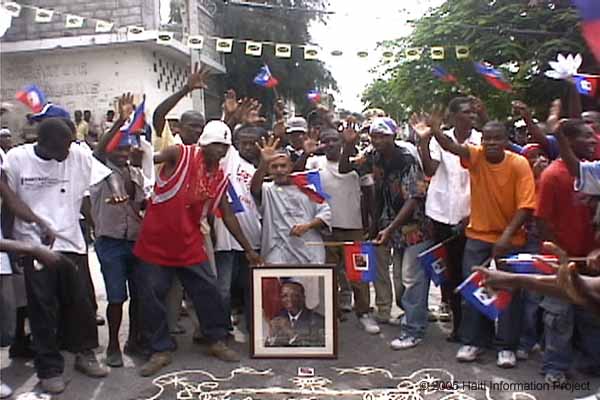
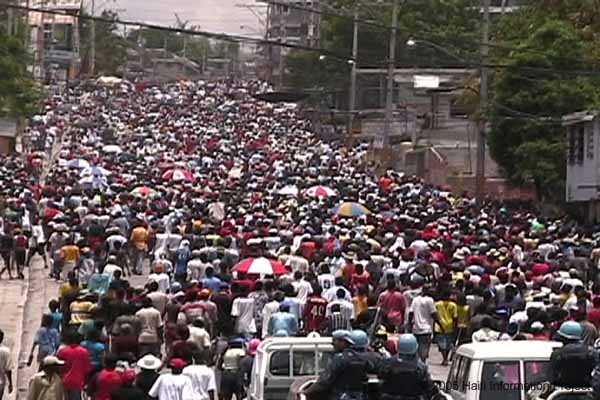
| An estimated 5,000 people marched in Port-au-Prince on Thursday, June 5, 2014 |
 |
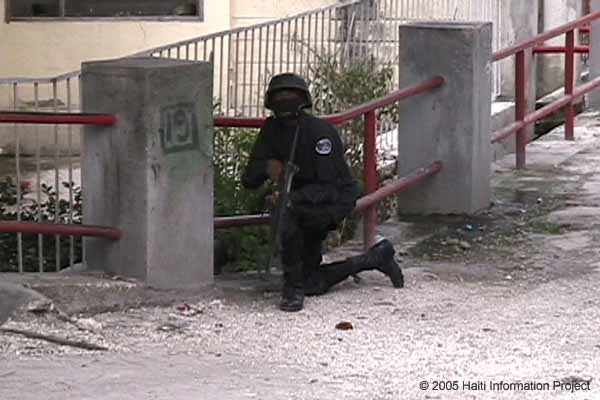
| Police fired tear gas at protesters and live ammunition into the air during demonstrations on June 10, 2014 |
At first glance, one might think Penn is correct for crowing about the handling of Haiti’s economy by his pals in the Martelly government given a recent International Monetary Fund (IMF) press release. On May 30 the IMF proclaimed, “Preliminary data for the first half of the fiscal year 2014 (i.e. October 2013 - March 2014) suggest that economic activity (as measured by gross domestic product, GDP), has advanced in line with projections, at a pace of about 3 – 4 percent. Inflation remained low, and it is projected to be in the mid-single digits by the end of the fiscal year (i.e. September 2014).”
 A closer
examination of historical statistics on the World Bank’s website shows that
Haiti’s annual GDP growth was actually at 5.6% when Martelly came to power
through highly controversial elections in 2011. GDP growth in Haiti then
dropped to 2.8% in 2012, rose to 4.3% in 2013 and is currently calculated at
3.6% for 2014 by the World Bank. Even if we take the IMF’s higher estimate of
4% GDP for 2014, that would mean that Haiti’s annual GDP actually shrank
by 1.2% since Martelly assumed office. And while inflation may have dropped from
8.4% in 2011 to 5.9% in 2013, the World Bank’s official assessment of the
overall economic condition in Haiti is far less rosy, “Over half of its population of
10 million lives on less than US$1 per day, and approximately 80% live on less
than US$2 per day. It is also one of the most unequal countries, with a Gini
coefficient of 0.59 as of 2001.”
A closer
examination of historical statistics on the World Bank’s website shows that
Haiti’s annual GDP growth was actually at 5.6% when Martelly came to power
through highly controversial elections in 2011. GDP growth in Haiti then
dropped to 2.8% in 2012, rose to 4.3% in 2013 and is currently calculated at
3.6% for 2014 by the World Bank. Even if we take the IMF’s higher estimate of
4% GDP for 2014, that would mean that Haiti’s annual GDP actually shrank
by 1.2% since Martelly assumed office. And while inflation may have dropped from
8.4% in 2011 to 5.9% in 2013, the World Bank’s official assessment of the
overall economic condition in Haiti is far less rosy, “Over half of its population of
10 million lives on less than US$1 per day, and approximately 80% live on less
than US$2 per day. It is also one of the most unequal countries, with a Gini
coefficient of 0.59 as of 2001.” Although arguably outdated, this last admission of income inequality has remained demonstrably true for as long as Haitians alive today can remember. It is perhaps the reality of the Gini coefficient that exposes Penn’s blind spot, namely that Haiti’s national economy still remains hostage to the dictates of a powerful wealthy elite. Given this, it appears Sean Penn's description of Haiti's current economic juncture as “turning a corner” is an exercise in hyperbole. This is especially true in the context of the billions of dollars in international development aid pumped into Haiti’s economy under the mantle of earthquake relief since Martelly became president.
While citing roads being paved and homes built, rebuilt and retrofitted since the earthquake is all well and good, Penn also offered this statement to demonstrate his bullish view of Haiti’s progress, “Crime rates have dropped, and in May 2011, one political party transferred power to another peacefully after an election for the first time in modern history.” Penn’s assertion that crime rates have dropped is not borne out by any available data as made clear by this Haiti 2014 Crime and Safety Report offered by the US Department of State Bureau of Diplomatic Security which states, “Reliable crime statistics are difficult to come by; Haitian National Police (HNP) numbers indicating a modest drop in crime during 2012 were undercut by those from other security entities operating in-country that continued to show a steady rise since 2010. A comparative analysis of figures from various police/security entities operating throughout Haiti reflects a continuation of the trend in which incidents of crimes are inaccurately or under-reported. Haiti’s perennially weak judiciary exacerbates an already unsteady security environment.”
 Penn’s next
assertion, that Martelly’s election in 2011 represented a peaceful democratic
transition, appears to be an absurd attempt to rewrite history. The violence preceding and following the first round of the November 2010 presidential elections in
Haiti is well documented. In fact, it is equally documented that most of the
violence was perpetrated by the supporters of Michel Martelly after it was
announced by the electoral council that Jude Célestin and Mirlande Manigat
would face each other in a second round of balloting. This violence led to an
infamous intervention in Haiti’s election process by the Organization of American States (OAS), backed by the US, to overturn the results. The
legitimacy of the election was already in question as “nearly three-quarters of
the electorate didn’t vote…” according to Mark Weisbrot of the Center for Economic and Policy Research (CEPR). Both rounds
of the presidential elections that brought Martelly to power were marked by low voter turnout as a result of
the banning of Haiti’s most popular political party, Fanmi Lavalas.
Penn’s next
assertion, that Martelly’s election in 2011 represented a peaceful democratic
transition, appears to be an absurd attempt to rewrite history. The violence preceding and following the first round of the November 2010 presidential elections in
Haiti is well documented. In fact, it is equally documented that most of the
violence was perpetrated by the supporters of Michel Martelly after it was
announced by the electoral council that Jude Célestin and Mirlande Manigat
would face each other in a second round of balloting. This violence led to an
infamous intervention in Haiti’s election process by the Organization of American States (OAS), backed by the US, to overturn the results. The
legitimacy of the election was already in question as “nearly three-quarters of
the electorate didn’t vote…” according to Mark Weisbrot of the Center for Economic and Policy Research (CEPR). Both rounds
of the presidential elections that brought Martelly to power were marked by low voter turnout as a result of
the banning of Haiti’s most popular political party, Fanmi Lavalas. Based on what the OAS called a “re-tabulation”, Martelly went on to the second round that also saw its share of documented violence and intimidation. Weisbrot described the outcome resulting from, “The OAS’ actions in taking the unprecedented step of overturning an election, without a recount or evidence for its action...”. Judging by the thousands of demonstrators who regularly take to the streets calling for Martelly’s resignation only to be dismissed by Sean Penn, it wasn’t just the credibility of the OAS that was lost in this process.
 |
| Penn and Michel Martelly in Haiti |
Finally, Sean Penn has done much to transform Haiti into a cause celebre through his own intervention including his acceptance to act as an Ambassador-at-large for the Martelly government. Blurring the line between humanitarian and political operative, he has married his reputation to that of Martelly and the success of the regime. This has arguably colored his interpretation and judgment of what “turning a corner” really looks like in Haiti. Penn's bias becomes more obvious when we take into account the facts he chooses to ignore and the social forces he regularly dismisses. It seems that in Penn's mind they are unworthy of equal billing when compared to his own relatively short-lived experience there.