Wednesday, May 27, 2020

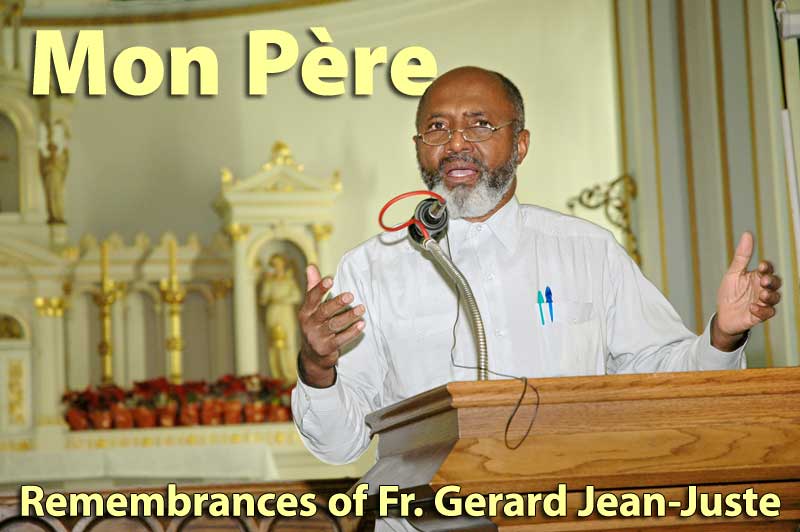
Mon Père, Remembrances of Fr. Gerard Jean-Juste in Haiti (May 29, 2009)

Originally Published May 29, 2009


Mon Père, Remembrances of Fr. Gerard Jean-Juste in Haiti

by Kevin Pina

I called Fr. Gerard Jean-Juste 'my father' as did so many others who worked with him and loved him for his courage, commitment and generosity. I first met this incredible man after the first coup against Aristide in 1991. Another Catholic liberation theology priest, Fr. Jean-Marie Vincent, introduced him to me. I had returned to Haiti to continue filming for my documentary Haiti: Harvest of Hope.

When I returned to Haiti Fr. Vincent told me that there was another priest assigned to the parish of St. Gerard in the capital of Port au Prince who was protecting and hiding those targeted by the military repression. At great personal risk and never asking anything in return, Fr. Jean-Juste developed an underground network of non-violent resistance to the military and police repression. His network would later expand to include opposition to the paramilitary forces created by the CIA such as the Front for Advancement and Progress in Haiti or FRAPH.

Fr. Jean-Juste was always clear in his intention. To console me after the assassination of Fr. Vincent in Aug. 1994 he said, "There is no such thing as a safe harbor against such brutality except in your own conscience. No matter how hard they try to kill the thirst of the majority of the poor for a better life in Haiti, their brutality and tactics only provide more water for our struggle. We must never let them set the terms for the liberation of the majority of the poor in Haiti with their acts of violence. We must always stay focused on the goal."

After Aristide's return to Haiti in 1994, Fr. Jean-Juste remained an anchor for the Lavalas movement that he believed represented the interests of the poor majority until his death this last Wednesday in a Miami hospital. For this conviction he would suffer dearly especially after accepting an assignment to St. Clare's church in the neighborhood of Ti Place Cazeau in Haiti's capital. Once there, he would continue to not only preach on behalf of the rights of Haiti's poor majority but would also put his faith into practice by creating community empowerment projects. These included literacy and economic programs providing the poor with opportunities to lift themselves out of poverty and a daily canteen that made hot meals available to the most vulnerable in the community. It was not uncommon to find him singing while serving meals to poor children, who he adored and honored as the future of Haiti, on any given afternoon at St. Clare's.

Following the second coup against Aristide in 2004, he lost his weekly radio program at Radio Ginen after anonymous threats against the station. He would never blame the owner of the station telling me, "I understand the forces of repression and the lies they tell have taken control of Haiti for the moment. They are trying to convince the world that our beautiful movement of the poor is ugly and desolate. Aristide was kidnapped after the elite cut a deal with the Bush administration and this much is clear, the repression against Lavalas has started again."

Fr. Jean-Juste would continue to preach that Lavalas was a beautiful movement of the poor while most of the world fell prey to a systematic campaign to label and isolate it as a violent aberration. He would use every opportunity to condemn the second ouster of Aristide as a "coup-napping" that relied upon the brutal force of the former military and death squads who had invaded Haiti from the Dominican Republic in early February 2004. Fr. Jean-Juste described the situation as, "The Bush administration hiding behind the pretext of death squads and the military to justify kidnapping our democratically elected president." This insistence earned him the love and respect of Haiti's poor majority along with regular condemnation and death threats from supporters of the coup.

Fr. Jean-Juste along with many others considered September 30, 2004 a true test and turning point for the Lavalas movement in Haiti. The Haitian police opened fired on unarmed protestors during a demonstration on the thirteenth anniversary of the first military coup against Aristide. The slaughter would be justified by Jean-Claude Bajeux, a so-called human rights advocate and leader of a ‘civil society organization' called the Group 184 that worked for Aristide's ouster. Bajeux claimed that Lavalas partisans had emulated terrorists in Iraq and beheaded police officers earlier in the day. The Latortue regime ran with it and borrowed Bajeaux's unfounded assertion that it was part of a terror campaign by Lavalas called "Operation Baghdad." The international community, already compromised and cajoled by the Bush administration, stood poised and ready to accept any explanation that provided a counter argument to the massive demonstrations in the streets calling for Aristide's return. The demonstrations were proving an embarrassing reminder that the so-called opposition to Aristide was really a minority and that he never lost the support of the masses of the Haitian people as they had claimed.

Associating Lavalas with terrorists in Iraq was a marketable product in the international press that would not only distract from the growing demonstrations but also serve to justify the increasing repression. In actuality, it was a continuation of the strategy the Bush administration had employed against the popular Haitian folksinger Annette Auguste in May 2004 justifying her arrest by claiming she was organizing with Muslims in a local mosque to attack U.S. Marines in Haiti.

Attempts by the Latortue regime and the international community to label Lavalas as a terrorist organization with Operation Baghdad were always ludicrous. Fr. Jean-Juste with his usual clarity would state, "Bush and the Organization of American States are trying to equate the resistance against the coup by the poor with Al-Qaida and Iraqi terrorists. The OAS is bought off and a disgrace to the memory of Haiti having helped Bolivar for the emancipation of Latin America. They along with the U.S., France and Canada are siding with the elite in Haiti who would rather use this foreign label to brand the Lavalas movement as terrorists than accept their own responsibility for having driven this country into the ground with their own greed."

The Latortue regime and its allies believed that Operation Baghdad had finally provided them with the excuse they needed to destroy Lavalas and repress its most vocal supporters. High on the list was Fr. Jean-Juste. After Sept. 30, I heard several radio interviews with Haitian police spokesperson Jesse Coicou accusing unnamed priests of harboring and assisting gunmen involved in Operation Baghdad. I knew whom they meant and called Fr. Jean-Juste to make sure he was safe. He seemed unconcerned and reminded me that part of their goal was to frighten any one who opposed the coup into silence. He finished with "It is in God's hands and we have to keep talking about what's really going on here. We have to keep doing our work."

On October 13, 2004 the UN allowed the former brutal military to ‘officially' enter the capital of Port-au-Prince unchallenged. As they paraded through the streets waving automatic weapons and promising to kill ‘Lavalas bandits,' Fr. Jean-Juste was serving meals to the children at St. Claire's parish. As the children ate, heavily armed police wearing black ski masks surrounded the church before entering the premises with their guns drawn. As the children watched in terror they brutalized Fr. Jean-Juste before dragging him out and throwing him into the back of a waiting police car.
Fr. Jean-Juste's arrest came in the midst of a campaign of unprecedented slaughter and mass arrests throughout Oct. and Nov. 2004. It was clearly meant to silence his criticism of what he considered crimes against humanity being committed by the Haitian police against poor communities in the capital. The repression and his arrest were justified by Operation Baghdad, as the Latin American countries in charge of the UN military mission, namely Brazil, Chile and Argentina, remained silent and continued to provide support to the Haitian National Police.

Despite the reality that no warrant was ever produced nor any evidence linking Fr. Jean-Juste to a crime ever presented, he was held in prison for more than six weeks. He was finally released under the cover of darkness at 2 o'clock in the morning on Nov. 29 to avoid the spectacle of thousands of Lavalas supporters gathering to celebrate the news. I called him later in the day to express my joy and arrange another interview. All he would say was "Kev, get over here. We can't start the party without you."

Fr. Jean-Juste began giving interviews right after his release in which he condemned the U.S., France and Canada for their role in the coup and the UN for backing the repression against the Lavalas movement. He declared that Latortue was leading a ‘regime of terror' and chastised the UN for their "despicable role in providing support to the Haitian police as they unjustly murder and jail thousands for their political convictions." It was statements like these and his popularity among the poor that made him an even larger target for the Latortue regime. All they needed was the right circumstances and a new pretext for hauling him back to prison. Fr. Jean-Juste knew this but refused to remain silent.


©2009 Kevin Pina

Saturday, March 2, 2019

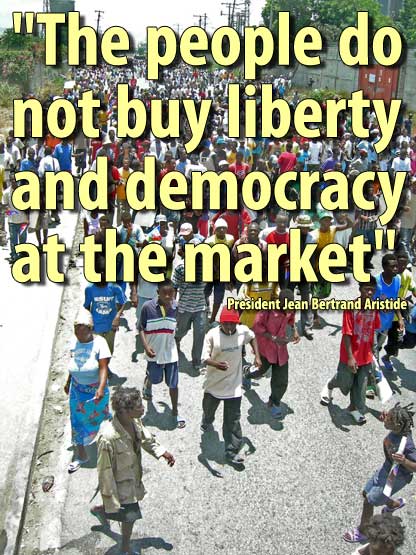
Haiti: "The people do not buy liberty and democracy at the market" - Aristide

Haiti: "The people do not buy liberty and democracy at the market"

by Kevin Pina

July 15, 2006 - Thousands supporting the Fanmi Lavalas political organization stream out of the poor neighborhoods of Cite Soley to join thousands more from other neighborhoods in Port au Prince to celebrate President Aristide's birthday ©2006 HIP/Lovinsky Pierre-Antione

Lavalas represents the majority political movement opposed to the neo-liberal economic model of development unfolding in Haiti today. Lavalas is the majority of Haitians without question who oppose the International Monetary Fund (IMF), the World Bank (WB) and the Inter-American Development Bank,(IADB)  project for "structural adjustment including eliminating import and export tariffs, selling off State-owned industries and businesses, a low minimum wage and an obsessive reliance on the private sector as the motor for economic development". Haiti's grassroots movement has named it "The Death Plan for Haiti" .

The major obstacle to the plan of the International Financial Institutions (IFIs) for the people of Haiti was democracy itself in the form of the Lavalas movement representing the interests of the majority of the poor, and their twice elected president, Jean Bertrand Aristide. He has been and currently is the symbol of resistance in the formation of the Lavalas movement for change in Haiti. Aristide's government refused to privatize key industries like the Telephone Company (Teleco) and the Electrical company (EDH) to accommodate the IFIs insistence social programs for all Haitian government programs be cut. The Fanmi Lavalas party would take profits from these same State-owned businesses and invest in a universal literacy and food program to provide millions of the poor with subsidized meals. For the first time in history Haiti had a safety net in place to insure against widespread hunger and malnutrition. Over the objections of the IFIs and Haiti's predatory economic elite, the minimum wage was doubled twice during Aristide's first and second terms raising wages for the lowest paid work force in the hemisphere. Not so coincidentally, both of Aristide's terms were cut short twice by a coup.

It should be abundantly clear to even the most casual observer by now that Aristide's social program was a major factor in the coup of Feb. 2004. It not only resulted in the ouster of the the democratically elected president but also eliminated more than 7,400 elected officials from municipal and national posts throughout Haiti. It represented no less than an attempt to destroy the movement of Haiti's poor majority and their right through elections to establish their own priorities for economic development based on the pillars of national sovereignty and social justice. The Bush administration and the Republican Party were up to the task as they backed Haiti's elite in overthrowing the constitutional government and orchestrating the "transition."

Far from the mythologized "popular rebellion" often repeated by the well-paid reporters of the corporate media, the ousting of democracy in Haiti in 2004 was a violent affair perpetrated by former military and death squad commanders that went on a killing spree. The paid minions of the wealthy elite who took to the streets to give the illusion of a popular rebellion could not succeed in taking down the government so the vile dogs of war were unleashed after being nurtured in the neighboring Dominican Republic. Not unlike recent events in Honduras, it resulted in a president being taken out of his home against his will under the cloak of darkness and forced onto a plane as the killing began in earnest to insure the success of the plotters.

The two years following the 2004 coup in Haiti would make the intentions of the Organization of American States, the United Nations and the international community clear as glass. They all gave their blessings to the US-installed regime that took power even as it unleashed an unprecedented campaign of summary executions, regular instances of gunning down unarmed protesters and arbitrary arrests. All of this done in the name of "restoring democracy." It was a period of gross human rights violations committed under the aegis of a UN banner that remains successfully cloaked and obscured to this day.

Faced with thousands killed, jailed and forced into exile, the Lavalas movement would elect Rene Preval their new president in 2006. Their hope was that he would stop the repression, free the political prisoners and allow Aristide to return to Haiti. What they could not know was that he had already signed onto the cynical project to destroy the popular movement of the poor as preparation for bringing Haiti back into the camp of neo-liberal economic development and the death plan they had fought so hard against.

Despite more than $4 billion dollars of international assistance since the 2004 coup life only got worse as Haiti's predatory economic elite were set free to squeeze as much profit as they could out of a desperate population. With little business investment to speak of, this elite would use their monopoly on the importation of food staples to steal away the more than $1.5 billion in remittances sent annually by thousands of families and friends to their loved ones in Haiti in an effort to keep them alive. It was always a sweetheart deal where these monopolists would insure the redistribution of wealth into their pockets even as protests broke out against the growing misery and hunger in April 2008.

Throughout, the Lavalas movement and the poor kept demonstrating against the coup demanding justice and that Aristide be allowed to return to Haiti. Their leaders would be disappeared as in the case of Lovinsky Pierre-Antoine on August 12, 2007, forced to rot away in prison like Ronald Dauphin or eventually succumb to the ravages of harsh treatment as that which befell Father Gerard Jean-Juste on May 27, 2009. Still others would be courted by Preval and offered well-paid positions of authority within his government if they would turn their backs on their own history and the Lavalas movement.

Then came the much-delayed senatorial elections in April and June 2009 where the final blow was to be delivered to Lavalas. The Fanmi Lavalas party would be excluded from participating on a technicality not because one actually existed as much as the possibility of their success in re-entering the political arena. Despite every attempt at that point to destroy their hope, Lavalas waged a successful boycott campaign of the elections that rendered them a joke by any objective standard of democratic participation. It was nothing less than a collective rebuff of Preval and the international community.

Kill, imprison, exile, divide, exclude and buy-off as many as you can is what presented itself as the long-term strategy to destroy Lavalas and pave the way for Haiti's re-emergence as a neo-liberal success story in the Caribbean. Still, Haiti's poor majority is a resilient and hopeful force. They hoped that with the election of Obama, as the first US president with African blood coursing through his veins that the trajectory of US-foreign policy in Haiti since the 2004 coup would change. It did not. They hoped that Hillary Clinton's appointment, as Secretary of State, would make a difference until she visited the sweatshop of coup backer Andy Apaid to tout the neo-liberal model last June. They hoped that Bill Clinton's appointment, as UN Special Envoy to Haiti, would signal a change until he went out of his way to ignore their pleas at every turn during his two brief visits over the last two months. Instead he spoke of coordinating NGO aid in preparation of instituting the new death plan as postulated by UN economic advisor Paul Collier, which is really the same old neo-liberal death plan as first exercised under Reagan's Caribbean Basin Initiative in the 80's. Just ignore history and put your name on it announcing it as new to an uncritical press. They won't know any better.

The IFIs announced in late June they forgave $1.2 billion dollars of Haiti's debt, most of which was racked up by former US-sponsored dictatorships and their partners in Haiti's wealthy elite that fed at their trough. It must be reassuring to go to bed at night in a sea of abject poverty knowing that you are the motor of economic development in the world and that you can do no wrong.

Now comes the final act to set the stage for Haiti's official return to neo-liberalism as the Haitian parliament just this week legislates the Haitian worker as the lowest paid in the hemisphere. They vote in a closed session to double the minimum wage to a whopping $3.75 a day or about $0.38 per hour for a normal ten-hour day. Haiti's "comparative advantage" under neo-liberal economic policy is solidified as cheap labor by holding down the price of wage labor in the hemisphere and the world. Haiti's advantage since Reagan has been to keep down wages in the hemisphere by being the cheapest labor force in the region against which all other labor forces must compete. It must be equally reassuring to know that despite that fact you can never make enough money working a 10-hour day to pull yourself out of poverty that you are doing your small part to keep the price of labor low so that US apparel manufacturers and their partners in the elite can turn a handsome profit. At minimum you can sleep well at night knowing that the US Congress is as hopeful as you are with legislation that provides US apparel manufacturers tax breaks to pay you that well-earned $3.75 per day that the Haitian parliament just approved.

All that's left is a platform for Haiti's former mistress of the NGO sector and current Prime Minister, Michele Duvivier Pierre-Louis, to take the stage with Bill Clinton to formally announce that the incubation period of the new-old death plan has given birth to renewed hope in Haiti. The corpses have been buried and the blood has been washed away so now Haiti can turn the page on the Lavalas movement and those upstarts in the poor majority who had the audacity to think that elections meant they could choose another alternative. Still, any analyst worth their salt that understands Haitian history would not take bets that this is over by a long shot.

It's only fitting to give Haiti's democratically elected president that was ousted in 2004 and remains in exile in the Republic of South Africa a few words here. Aristide once said, "Pèp pa achte libète ak demokrasi nan mache" or "The people do not buy liberty and democracy at the market." It seems that in today's world almost anything is possible with a Democrat in the White House and a Democratic Congress who owe their success to running on a platform for "Change we can believe in." Either way the lesson for the world's poor remains the same; when it comes to the Democratic Party don't confuse hope with change especially if that's all you're going to be paid for a 10-hour day.


The Haiti Information Project (HIP) is a non-profit alternative news service providing coverage and analysis of breaking developments in Haiti. Winner of the CENSORED 2008 REAL NEWS AWARD for Outstanding Investigative Journalism. For further information about the Haiti Information Project (HIP) visit: http://haitiinformationproject.blogspot.com/
Contact: editorial@HaitiinformationProject.net

©2009 Haiti Information Project