Wednesday, March 10, 2021

Fanmi Lavalas calls for “Sali Piblik” in #Haiti


ORIGINAL ARTICLE: https://haitisolidarity.net/fanmi-lavalas-calls-for-sali-piblik/

Fanmi Lavalas supports the masses of the Haitian people in their call for “Sali Piblik” or a people’s government of public safety in opposition to an oligarchy backed by the US, UN and OAS determined to perpetuate a system of exclusion. Watch this short video with english voice-over [english trans. by Haiti Action Committee] to learn more.

English text:

Feb. 14, 2021 over 100,000 denounce Jovenel Moise dictatorship in Port-au-Prince

Fanmi Lavalas Political Organization fully supports the people of Haiti who say that the system is totally broken. Our people are calling for an executive and a government that guarantees the public’s safety. Why Public Safety?

It is clear to all that the three branches of government have collapsed. The order of the day corruption, organized crime, impunity, theft, plunder, social exclusion, miserable living conditions and desperation. The executive, legislative and judiciary have come together as one to crush the Haitian people. People have absolutely no trust in this government.

Fanmi Lavalas published a document titled “Crisis and Solution” on November 15, 2018. We stated that, after the resignation of Jovenel Moise (indicted president) who was imposed as a result of the 2016 electoral coup d’etat, there will have to be a new executive and a government of public safety to make the transition. Which individuals will lead the transition? They will be people who are honest and credible; they are in the country. People who believe in transparency, in the struggle against social exclusion, corruption, people who believe in a different form of governance. They will restore trust between the people and the state.

Let us look at some of the major steps that the transition government will have to take:
1) Improve the living conditions of the population through an effective management of state resources
2) Create proper conditions for the legal case regarding the PetroCaribe funds
3) Organize a real national dialogue.
4) Revise the electoral law in order to organize credible elections in the country
5) Organize a constitutional committee

The transition will lay the foundation for the new system that all Haitians aspire to. That is a system based on Social Justice, Transparency and Participation. Where there will be no more social exclusion. We will be investing in people so that everyone can live as human beings because every person is a human being. As President Aristide always says ‘If we don’t safeguard our dignity, we will lose it.’ Alone we are weak, together we are strong, all together we are Lavalas!”
English translation of the full Fanmi Lavalas proposal titled “Crisis and Resolution” originally published in November 2018 can be accessed at this link: https://haitisolidarity.net/crisis-and-resolution/.”

Background to #Haiti's Lavalas movement's call for “Sali Piblik” or “Public Salvation”


Fanmi Lavalas Statement, 11-15-18

This is an unofficial translation by Haiti Action Committee.

There is a grave crisis in contemporary Haitian society, in which the masses of our people are opposing an oligarchy determined to perpetuate a system of exclusion.

 There have been many bumps in the road since February, 1986, when our people overthrew the Duvalier regime. Several coups d’etat have occurred, with the most damaging to the population having taken place in 1991 and 2004. Despite continued battering by the repressive and ideological machine, the more conscious and militant sectors of the population have stood firm; their resistance has been constant despite periods of setback.

At the present time, we are witnessing a general awakening of national consciousness. In addition to the population rising up to insist on better living conditions, with demands coming from many different sectors, including workers, peasants, educators, and students, the scandal involving the embezzling of the Petro-Caribe funds has provoked a big upsurge in mobilization against corruption and impunity. As so often occurs throughout history, the Petro-Caribe scandal has raised the awareness of the overwhelming majority about the unjust economic and political system, revealing the cause-and-effect relationship between this system and the sufferings of the Haitian people. Large masses of the population have come to understand with greater clarity and intensity the urgent necessity to take their destiny in their own hands.  

As usually occurs during periods of dynamic struggle such as the present, the oligarchy is fractured. Attempting to maintain the status quo, it is faced with internal contradictions regarding the strategy that would allow it to save “the system”—a sham institutional “democracy” set within a framework of an economic and social regime based on glaring inequalities, a stranglehold on political power that excludes the popular masses, and the pillage of national resources.  

Fanmi Lavalas Political Organization is always closely tuned in to the various sectors of the population, and our conclusion is obvious: it is time for the political class to muster the courage to initiate a profound change in the paradigm and structures of governance that characterize the present system. This is a necessity that has a wide consensus as manifested by the ever-growing magnitude of anti-government mobilization that we are witnessing today. It is imperative that we respect the people’s aspirations for progress and for a just society. It is paramount that we stand in solidarity with the people’s protests demanding a new form of state. The nation deserves a new system that is more in harmony with the dreams of our founders, a new vision of the Republic rooted in Justice, Transparency and Participation.

The population is rejecting the usurpers who have derived their power from the fraudulent elections and who have discredited themselves with multiple scandals involving corruption and impunity. Our people are facing savage repression that continues to create victims among the disadvantaged masses, and that is heightening the insecurity that is poisoning daily life for the majority. Fanmi Lavalas Political Organization continues to stand firmly with the Haitian people to “chavire chodyè a” (overturn the cauldron). No cosmetic solution will bring an effective and lasting solution to the crisis in which we are plunged.This system has run its course. It cannot be patched up. It must be changed.

Chavire chodyè a” (Overturn the cauldron) means that we consider this moment to be exceptional. The deterioration of the political situation, the degradation of the economy and public finances, the failure of the state and its institutions, the lack of legitimacy and the absence of credibility at all levels of the state apparatus, make illusory if not impossible an end to the crisis by so-called constitutional means. The conditions for a new beginning that will put the country back on track, in keeping with the demands of the overwhelming majority, require an exceptional approach. For Fanmi Lavalas this includes:

1) Obtain the resignation of Jovenel Moise through a general mobilization

2) Resignation of Jean Henry Ceant and all his ministers

3) Assess the dysfunction and lapses in the Parliament

4) Put in place an executive and a government of public safety to ensure a transition for a period of 36 months.

This transition government will consist of credible personalities, engaged in the struggle against exclusion and corruption, who share a vision of a new method of governance. Among the priorities to be included:

a) Improve the living conditions of the population by the sound and efficient management of current priorities pending the installation of an elected government.

b) Create a constituent assembly for a new fundamental charter that will define the features of the new Republic.

 c) Organize a necessary national dialogue.

d) Create the conditions that will end impunity and allow for a trial of those who have absconded with the Petro-Caribe funds.   

e) Take all measures to revise the Electoral Law and appoint a new electoral council charged with organizing elections to close out the transition period

The transition aims to implement fundamental reforms that would allow a democratic process and would make possible free, honest and credible elections. The transition must restore confidence between the people and the state. In this light the demands of the popular masses must be taken into account on all issues. True to its commitment to social justice and participation, Fanmi Lavalas will play its role alongside the population in continuing to promote the dialogue that is indispensable among the sons and daughters of the same land.    

Executive Committee of Fanmi Lavalas
Dr. Maryse Narcisse 
M. Joël Vorbe 
Dr. Jean Myrto Julien
Agr. Anthony Dessources

Wednesday, May 27, 2020

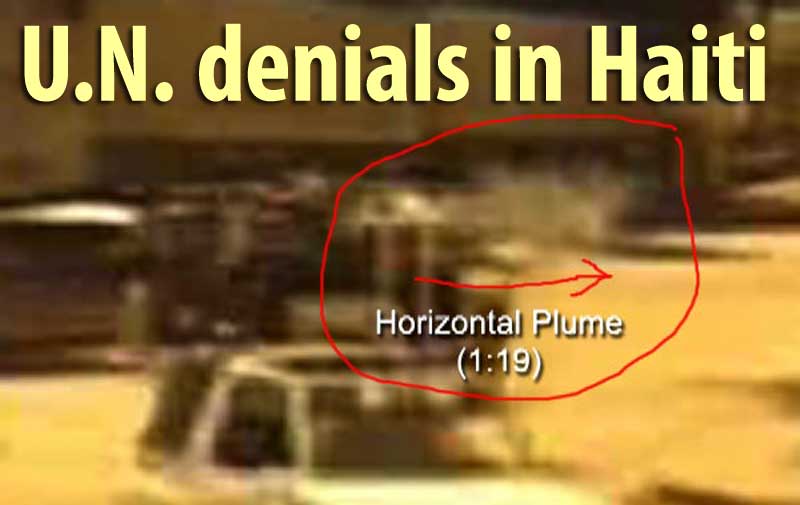
UN denials in Haiti...even in death they would try to dishonor the memory of Father Gerard Jean-Juste (Originally published June 30, 2009)

After the first shot is fired we see a horizontal plume of gun smoke that clearly shows the firearm was discharged at crowd level.
After the first shot is fired we see a horizontal plume of gun smoke
that clearly shows the firearm was discharged at crowd level.


by Kevin Pina

Haitian priest Father Gerard Jean-Juste, a symbol of strength, courage and leadership to a great many, was to be laid to rest by his family, friends and supporters on June 18. Few expected the solemn occasion would be transformed into confusion and terror as U.N. forces opened fire towards Haiti's national cathedral following the arrest of one of the mourners. A victim of a single gunshot wound to the head would be discovered moments later. Witnesses say his body writhed and convulsed struggling with the inevitable as blood slowly formed a crimson background around his head.
 
Jean-Juste would probably not be surprised by the shooting given that he was a leader of Lavalas and this was after all a Lavalas funeral. He would most likely recall many other instances of human rights abuses committed against Lavalas where the U.N. was complicit or directly involved.  He would often criticize the U.N. mission in Haiti for killing unarmed civilians in Cite Soleil and for training the Haitian police as they regularly shot up peaceful demonstrations, performed summary executions and falsely arrested Lavalas supporters following the ouster of Aristide in Feb. 2004. Jean-Juste more than most, would understand that this incident is but one more in a long list of violent offenses committed against the movement of the majority of the poor in Haiti as part of the U.N.'s current experiment in political landscaping.


kipman
The first shot is immediately followed by a second muzzle flash and audio of 
a shot fired towards the camera and and in the direction of the cathedral.

Public revulsion over this recent unprovoked shooting by U.N. soldiers in Haiti is only surpassed by disgust at the U.N.'s attempt to cover it up. The commander of MINUSTAH, Brazilian General Floriano Peixoto orchestrated immediately, "The truth is I do not believe... that the soldiers fired on the people with live ammunition...I'm convinced that this did not happen." The U.N. then released a statement through its songbird Michelle Montas in New York that said they "categorically denied" any of its soldiers were involved in the death. Agence France Presse played the tune, "The UN Stabilization Mission in Haiti (MINUSTAH) insisted also that the death, initially attributed to a gun shot wound, was due to a "head injury inflicted by a stone or a blunt object."" The Associated Press (AP) chimed in, "[MINUSTAH] cited unspecified preliminary information that the victim was killed by a blunt object, such as a thrown rock, rather than a bullet." The fact that the U.N.'s version of the killing was based on ‘unspecified preliminary information' didn't seem to matter much to the chorus at the time.

The U.N.'s attempt at a cover-up came into focus after a Haitian TV station, Radio Tele-Ginen, streamed coverage of the funeral of Father Gerard Jean-Juste live over the Internet. Thousands watched as U.N. soldiers fired into the air and it was only after they had left the scene that the camera showed the body of the victim. This led AP reporter Jonathan Katz to comment on June 19, "The video did not appear to show what happened to the man, showing only some U.N. soldiers arresting another man and firing shots into the air." Katz concluded, "The soldiers load the protester into the truck and fire two more shots as they drive away, followed by a Haitian police vehicle." 

Radio Tele-Ginen then dropped a bombshell and released footage from another camera angle that actually showed Brazilian soldiers firing at crowd level from the back of a small white pickup truck as they left the scene. There is no police vehicle following them as Katz claims and you can clearly see that no one was throwing rocks at them or any where near the soldiers as they casually fire off two shots from the back of the truck. Thirty seconds later a man is discovered in front of Haiti's national cathedral felled by what is clearly a single gunshot wound to the head.
 
From the footage alone any one who has ever seen a victim of a headshot could easily tell his wound was not inflicted by a rock or blunt instrument as the U.N. claimed. The ‘rock of blunt instrument' spin was a cynical attempt by the U.N. to imply that a fellow mourner was responsible for the death during a funeral organized by Lavalas for one of their own. They were correct in thinking that a gullible international press would repeat the ridiculous assertion given the latter has long participated in creating a spoon feed image of Lavalas as a violent political movement.
 
Eleven days after the shooting the other shoe would finally drop. On June 29, the final results of an autopsy would reveal that the victim was indeed killed by a wound resulting from a single shot to the head. In a fantastically surreal statement of further denial U.N. peacekeeping spokeswoman Sophie Boutaud de la Combe would respond, "We are confident that the autopsy reconfirmed that our troops were not responsible for this death." It seems that someone forgot to tell Sophie that if you're going to spin for denial it has to at least have some possibility of being taken seriously.
 
Writing for AP, Katz would soften the realization that the U.N. had lied about the victim's fatal wound in a ‘matter of fact' tone, "[Boutaud de la Combe] noted that preliminary information that the protester had been killed by a rock or other blunt instrument were incorrect." Katz would continue to provide the U.N. with plausible deniability when he wrote, "In television footage of the clash at least eight shots can be heard. It is not clear if all were fired by the soldiers." He would at least have the decency to add the qualifier, "No one else is seen holding a firearm."
 
The fact that the Radio Tele-Ginen footage from June 18 shows Brazilian soldiers opening fire without any provocation speaks volumes. The casual nature with which they discharge their weapons as they leave the scene makes it appear as if they were sending a message to the mourners and Lavalas. It was message of violence and terror that has been repeated over and over again for the Lavalas movement since Feb. 2004. That this particular volley would come four days before the second round of Senate elections in Haiti is clearly not a coincidence.
 
After the Fanmi Lavalas party was barred from participating in Senate elections, they waged a highly successful boycott campaign of the first round held on April 19. Another successful boycott of the second round on June 21 would be a crushing repudiation of the U.N.'s attempt to legitimize their mission through ‘helping the Haitian people to realize democracy.' If the U.N. cannot oversee a process of fair and inclusive elections in Haiti then there really is not much point in them continuing to press to extend their mission is there? The only thing standing between them passing off exclusive elections or "selections" as credible was the Lavalas movement. The message delivered by U.N. soldiers firing indiscriminately at the crowd during Jean-Juste's funeral was to back off from the boycott and Lavalas's political campaign or the killings and arrests would start again. Desecrating the funeral of one of Lavalas's revered leaders and associating his cortège with violence would pave the way. 
 
In the end, despite tremendous financial and political efforts by the U.N., Lavalas successfully boycotted the second round of Senate elections. Turnout was lower than the first round and other than inflated figures provided by the election council most observers admit that very few people showed up to vote in either election. Just like denials of firing at crowd level on June 18 and the head wound of the victim, the U.N. and the international press that feeds off them also continue to deny the successful boycott campaign. One can almost hear the collective mantra of Brazilian General Floriano Peixoto, Sophie Boutaud de la Combe, Michelle Montas, Jonathan Katz and others that the boycott had little to do with the low voter turnout.  Voter fatigue, off-season elections, fatigue with ineffective government, a loss of faith in politicians and everything else under the sun except the boycott.
 
Leaders of the Lavalas Mobilization Commission, organizers of the boycott, have made it clear that the Haitian people see their new Senators as ‘creatures of the U.N. and the international community.' They do not recognize the elections as credible and say they will continue to demonstrate peacefully to have them annulled. If June 18 is any indication of what's to come, the U.N. is gearing up for a new round of the blame the victim style of repression that has come to define their current mission's relationship to the Lavalas movement. As events unfold, we can only hope that a few brave journalists will keep the cameras rolling so that we might have some small chance of seeing the truth behind the denials.

The Haiti Information Project (HIP) is a non-profit alternative news service providing coverage and analysis of breaking developments in Haiti.

Winner of the CENSORED 2008 REAL NEWS AWARD for Outstanding Investigative Journalism


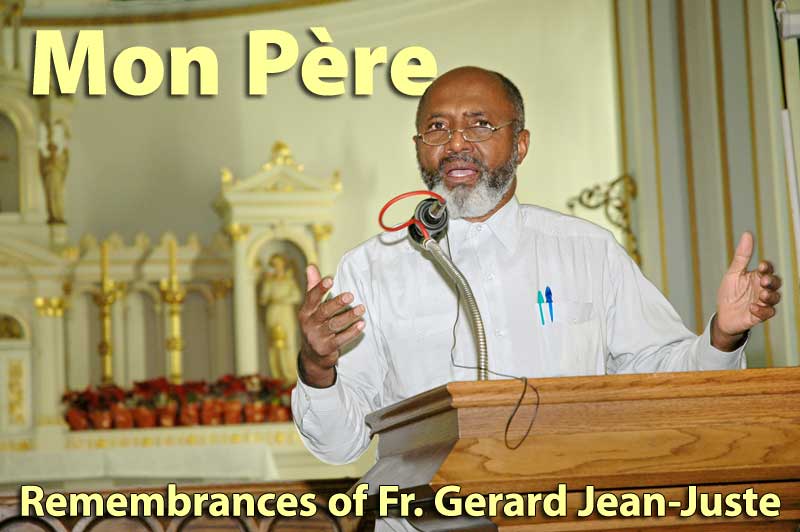
Mon Père, Remembrances of Fr. Gerard Jean-Juste in Haiti (May 29, 2009)

Originally Published May 29, 2009


Mon Père, Remembrances of Fr. Gerard Jean-Juste in Haiti

by Kevin Pina

I called Fr. Gerard Jean-Juste 'my father' as did so many others who worked with him and loved him for his courage, commitment and generosity. I first met this incredible man after the first coup against Aristide in 1991. Another Catholic liberation theology priest, Fr. Jean-Marie Vincent, introduced him to me. I had returned to Haiti to continue filming for my documentary Haiti: Harvest of Hope.

When I returned to Haiti Fr. Vincent told me that there was another priest assigned to the parish of St. Gerard in the capital of Port au Prince who was protecting and hiding those targeted by the military repression. At great personal risk and never asking anything in return, Fr. Jean-Juste developed an underground network of non-violent resistance to the military and police repression. His network would later expand to include opposition to the paramilitary forces created by the CIA such as the Front for Advancement and Progress in Haiti or FRAPH.

Fr. Jean-Juste was always clear in his intention. To console me after the assassination of Fr. Vincent in Aug. 1994 he said, "There is no such thing as a safe harbor against such brutality except in your own conscience. No matter how hard they try to kill the thirst of the majority of the poor for a better life in Haiti, their brutality and tactics only provide more water for our struggle. We must never let them set the terms for the liberation of the majority of the poor in Haiti with their acts of violence. We must always stay focused on the goal."

After Aristide's return to Haiti in 1994, Fr. Jean-Juste remained an anchor for the Lavalas movement that he believed represented the interests of the poor majority until his death this last Wednesday in a Miami hospital. For this conviction he would suffer dearly especially after accepting an assignment to St. Clare's church in the neighborhood of Ti Place Cazeau in Haiti's capital. Once there, he would continue to not only preach on behalf of the rights of Haiti's poor majority but would also put his faith into practice by creating community empowerment projects. These included literacy and economic programs providing the poor with opportunities to lift themselves out of poverty and a daily canteen that made hot meals available to the most vulnerable in the community. It was not uncommon to find him singing while serving meals to poor children, who he adored and honored as the future of Haiti, on any given afternoon at St. Clare's.

Following the second coup against Aristide in 2004, he lost his weekly radio program at Radio Ginen after anonymous threats against the station. He would never blame the owner of the station telling me, "I understand the forces of repression and the lies they tell have taken control of Haiti for the moment. They are trying to convince the world that our beautiful movement of the poor is ugly and desolate. Aristide was kidnapped after the elite cut a deal with the Bush administration and this much is clear, the repression against Lavalas has started again."

Fr. Jean-Juste would continue to preach that Lavalas was a beautiful movement of the poor while most of the world fell prey to a systematic campaign to label and isolate it as a violent aberration. He would use every opportunity to condemn the second ouster of Aristide as a "coup-napping" that relied upon the brutal force of the former military and death squads who had invaded Haiti from the Dominican Republic in early February 2004. Fr. Jean-Juste described the situation as, "The Bush administration hiding behind the pretext of death squads and the military to justify kidnapping our democratically elected president." This insistence earned him the love and respect of Haiti's poor majority along with regular condemnation and death threats from supporters of the coup.

Fr. Jean-Juste along with many others considered September 30, 2004 a true test and turning point for the Lavalas movement in Haiti. The Haitian police opened fired on unarmed protestors during a demonstration on the thirteenth anniversary of the first military coup against Aristide. The slaughter would be justified by Jean-Claude Bajeux, a so-called human rights advocate and leader of a ‘civil society organization' called the Group 184 that worked for Aristide's ouster. Bajeux claimed that Lavalas partisans had emulated terrorists in Iraq and beheaded police officers earlier in the day. The Latortue regime ran with it and borrowed Bajeaux's unfounded assertion that it was part of a terror campaign by Lavalas called "Operation Baghdad." The international community, already compromised and cajoled by the Bush administration, stood poised and ready to accept any explanation that provided a counter argument to the massive demonstrations in the streets calling for Aristide's return. The demonstrations were proving an embarrassing reminder that the so-called opposition to Aristide was really a minority and that he never lost the support of the masses of the Haitian people as they had claimed.

Associating Lavalas with terrorists in Iraq was a marketable product in the international press that would not only distract from the growing demonstrations but also serve to justify the increasing repression. In actuality, it was a continuation of the strategy the Bush administration had employed against the popular Haitian folksinger Annette Auguste in May 2004 justifying her arrest by claiming she was organizing with Muslims in a local mosque to attack U.S. Marines in Haiti.

Attempts by the Latortue regime and the international community to label Lavalas as a terrorist organization with Operation Baghdad were always ludicrous. Fr. Jean-Juste with his usual clarity would state, "Bush and the Organization of American States are trying to equate the resistance against the coup by the poor with Al-Qaida and Iraqi terrorists. The OAS is bought off and a disgrace to the memory of Haiti having helped Bolivar for the emancipation of Latin America. They along with the U.S., France and Canada are siding with the elite in Haiti who would rather use this foreign label to brand the Lavalas movement as terrorists than accept their own responsibility for having driven this country into the ground with their own greed."

The Latortue regime and its allies believed that Operation Baghdad had finally provided them with the excuse they needed to destroy Lavalas and repress its most vocal supporters. High on the list was Fr. Jean-Juste. After Sept. 30, I heard several radio interviews with Haitian police spokesperson Jesse Coicou accusing unnamed priests of harboring and assisting gunmen involved in Operation Baghdad. I knew whom they meant and called Fr. Jean-Juste to make sure he was safe. He seemed unconcerned and reminded me that part of their goal was to frighten any one who opposed the coup into silence. He finished with "It is in God's hands and we have to keep talking about what's really going on here. We have to keep doing our work."

On October 13, 2004 the UN allowed the former brutal military to ‘officially' enter the capital of Port-au-Prince unchallenged. As they paraded through the streets waving automatic weapons and promising to kill ‘Lavalas bandits,' Fr. Jean-Juste was serving meals to the children at St. Claire's parish. As the children ate, heavily armed police wearing black ski masks surrounded the church before entering the premises with their guns drawn. As the children watched in terror they brutalized Fr. Jean-Juste before dragging him out and throwing him into the back of a waiting police car.
Fr. Jean-Juste's arrest came in the midst of a campaign of unprecedented slaughter and mass arrests throughout Oct. and Nov. 2004. It was clearly meant to silence his criticism of what he considered crimes against humanity being committed by the Haitian police against poor communities in the capital. The repression and his arrest were justified by Operation Baghdad, as the Latin American countries in charge of the UN military mission, namely Brazil, Chile and Argentina, remained silent and continued to provide support to the Haitian National Police.

Despite the reality that no warrant was ever produced nor any evidence linking Fr. Jean-Juste to a crime ever presented, he was held in prison for more than six weeks. He was finally released under the cover of darkness at 2 o'clock in the morning on Nov. 29 to avoid the spectacle of thousands of Lavalas supporters gathering to celebrate the news. I called him later in the day to express my joy and arrange another interview. All he would say was "Kev, get over here. We can't start the party without you."

Fr. Jean-Juste began giving interviews right after his release in which he condemned the U.S., France and Canada for their role in the coup and the UN for backing the repression against the Lavalas movement. He declared that Latortue was leading a ‘regime of terror' and chastised the UN for their "despicable role in providing support to the Haitian police as they unjustly murder and jail thousands for their political convictions." It was statements like these and his popularity among the poor that made him an even larger target for the Latortue regime. All they needed was the right circumstances and a new pretext for hauling him back to prison. Fr. Jean-Juste knew this but refused to remain silent.


©2009 Kevin Pina

Saturday, March 2, 2019

Haiti: "The people do not buy liberty and democracy at the market" - Aristide

Haiti: "The people do not buy liberty and democracy at the market"

by Kevin Pina

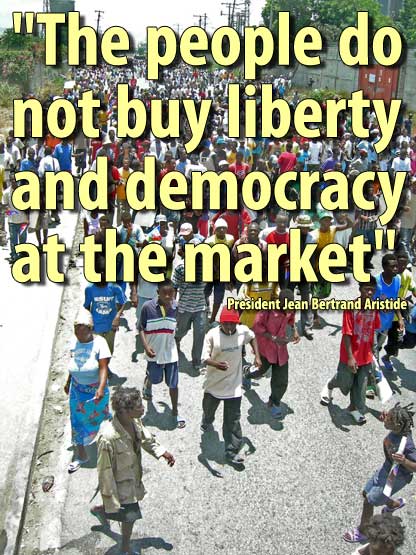
July 15, 2006 - Thousands supporting the Fanmi Lavalas political organization stream out of the poor neighborhoods of Cite Soley to join thousands more from other neighborhoods in Port au Prince to celebrate President Aristide's birthday ©2006 HIP/Lovinsky Pierre-Antione

Lavalas represents the majority political movement opposed to the neo-liberal economic model of development unfolding in Haiti today. Lavalas is the majority of Haitians without question who oppose the International Monetary Fund (IMF), the World Bank (WB) and the Inter-American Development Bank,(IADB)  project for "structural adjustment including eliminating import and export tariffs, selling off State-owned industries and businesses, a low minimum wage and an obsessive reliance on the private sector as the motor for economic development". Haiti's grassroots movement has named it "The Death Plan for Haiti" .

The major obstacle to the plan of the International Financial Institutions (IFIs) for the people of Haiti was democracy itself in the form of the Lavalas movement representing the interests of the majority of the poor, and their twice elected president, Jean Bertrand Aristide. He has been and currently is the symbol of resistance in the formation of the Lavalas movement for change in Haiti. Aristide's government refused to privatize key industries like the Telephone Company (Teleco) and the Electrical company (EDH) to accommodate the IFIs insistence social programs for all Haitian government programs be cut. The Fanmi Lavalas party would take profits from these same State-owned businesses and invest in a universal literacy and food program to provide millions of the poor with subsidized meals. For the first time in history Haiti had a safety net in place to insure against widespread hunger and malnutrition. Over the objections of the IFIs and Haiti's predatory economic elite, the minimum wage was doubled twice during Aristide's first and second terms raising wages for the lowest paid work force in the hemisphere. Not so coincidentally, both of Aristide's terms were cut short twice by a coup.

It should be abundantly clear to even the most casual observer by now that Aristide's social program was a major factor in the coup of Feb. 2004. It not only resulted in the ouster of the the democratically elected president but also eliminated more than 7,400 elected officials from municipal and national posts throughout Haiti. It represented no less than an attempt to destroy the movement of Haiti's poor majority and their right through elections to establish their own priorities for economic development based on the pillars of national sovereignty and social justice. The Bush administration and the Republican Party were up to the task as they backed Haiti's elite in overthrowing the constitutional government and orchestrating the "transition."

Far from the mythologized "popular rebellion" often repeated by the well-paid reporters of the corporate media, the ousting of democracy in Haiti in 2004 was a violent affair perpetrated by former military and death squad commanders that went on a killing spree. The paid minions of the wealthy elite who took to the streets to give the illusion of a popular rebellion could not succeed in taking down the government so the vile dogs of war were unleashed after being nurtured in the neighboring Dominican Republic. Not unlike recent events in Honduras, it resulted in a president being taken out of his home against his will under the cloak of darkness and forced onto a plane as the killing began in earnest to insure the success of the plotters.

The two years following the 2004 coup in Haiti would make the intentions of the Organization of American States, the United Nations and the international community clear as glass. They all gave their blessings to the US-installed regime that took power even as it unleashed an unprecedented campaign of summary executions, regular instances of gunning down unarmed protesters and arbitrary arrests. All of this done in the name of "restoring democracy." It was a period of gross human rights violations committed under the aegis of a UN banner that remains successfully cloaked and obscured to this day.

Faced with thousands killed, jailed and forced into exile, the Lavalas movement would elect Rene Preval their new president in 2006. Their hope was that he would stop the repression, free the political prisoners and allow Aristide to return to Haiti. What they could not know was that he had already signed onto the cynical project to destroy the popular movement of the poor as preparation for bringing Haiti back into the camp of neo-liberal economic development and the death plan they had fought so hard against.

Despite more than $4 billion dollars of international assistance since the 2004 coup life only got worse as Haiti's predatory economic elite were set free to squeeze as much profit as they could out of a desperate population. With little business investment to speak of, this elite would use their monopoly on the importation of food staples to steal away the more than $1.5 billion in remittances sent annually by thousands of families and friends to their loved ones in Haiti in an effort to keep them alive. It was always a sweetheart deal where these monopolists would insure the redistribution of wealth into their pockets even as protests broke out against the growing misery and hunger in April 2008.

Throughout, the Lavalas movement and the poor kept demonstrating against the coup demanding justice and that Aristide be allowed to return to Haiti. Their leaders would be disappeared as in the case of Lovinsky Pierre-Antoine on August 12, 2007, forced to rot away in prison like Ronald Dauphin or eventually succumb to the ravages of harsh treatment as that which befell Father Gerard Jean-Juste on May 27, 2009. Still others would be courted by Preval and offered well-paid positions of authority within his government if they would turn their backs on their own history and the Lavalas movement.

Then came the much-delayed senatorial elections in April and June 2009 where the final blow was to be delivered to Lavalas. The Fanmi Lavalas party would be excluded from participating on a technicality not because one actually existed as much as the possibility of their success in re-entering the political arena. Despite every attempt at that point to destroy their hope, Lavalas waged a successful boycott campaign of the elections that rendered them a joke by any objective standard of democratic participation. It was nothing less than a collective rebuff of Preval and the international community.

Kill, imprison, exile, divide, exclude and buy-off as many as you can is what presented itself as the long-term strategy to destroy Lavalas and pave the way for Haiti's re-emergence as a neo-liberal success story in the Caribbean. Still, Haiti's poor majority is a resilient and hopeful force. They hoped that with the election of Obama, as the first US president with African blood coursing through his veins that the trajectory of US-foreign policy in Haiti since the 2004 coup would change. It did not. They hoped that Hillary Clinton's appointment, as Secretary of State, would make a difference until she visited the sweatshop of coup backer Andy Apaid to tout the neo-liberal model last June. They hoped that Bill Clinton's appointment, as UN Special Envoy to Haiti, would signal a change until he went out of his way to ignore their pleas at every turn during his two brief visits over the last two months. Instead he spoke of coordinating NGO aid in preparation of instituting the new death plan as postulated by UN economic advisor Paul Collier, which is really the same old neo-liberal death plan as first exercised under Reagan's Caribbean Basin Initiative in the 80's. Just ignore history and put your name on it announcing it as new to an uncritical press. They won't know any better.

The IFIs announced in late June they forgave $1.2 billion dollars of Haiti's debt, most of which was racked up by former US-sponsored dictatorships and their partners in Haiti's wealthy elite that fed at their trough. It must be reassuring to go to bed at night in a sea of abject poverty knowing that you are the motor of economic development in the world and that you can do no wrong.

Now comes the final act to set the stage for Haiti's official return to neo-liberalism as the Haitian parliament just this week legislates the Haitian worker as the lowest paid in the hemisphere. They vote in a closed session to double the minimum wage to a whopping $3.75 a day or about $0.38 per hour for a normal ten-hour day. Haiti's "comparative advantage" under neo-liberal economic policy is solidified as cheap labor by holding down the price of wage labor in the hemisphere and the world. Haiti's advantage since Reagan has been to keep down wages in the hemisphere by being the cheapest labor force in the region against which all other labor forces must compete. It must be equally reassuring to know that despite that fact you can never make enough money working a 10-hour day to pull yourself out of poverty that you are doing your small part to keep the price of labor low so that US apparel manufacturers and their partners in the elite can turn a handsome profit. At minimum you can sleep well at night knowing that the US Congress is as hopeful as you are with legislation that provides US apparel manufacturers tax breaks to pay you that well-earned $3.75 per day that the Haitian parliament just approved.

All that's left is a platform for Haiti's former mistress of the NGO sector and current Prime Minister, Michele Duvivier Pierre-Louis, to take the stage with Bill Clinton to formally announce that the incubation period of the new-old death plan has given birth to renewed hope in Haiti. The corpses have been buried and the blood has been washed away so now Haiti can turn the page on the Lavalas movement and those upstarts in the poor majority who had the audacity to think that elections meant they could choose another alternative. Still, any analyst worth their salt that understands Haitian history would not take bets that this is over by a long shot.

It's only fitting to give Haiti's democratically elected president that was ousted in 2004 and remains in exile in the Republic of South Africa a few words here. Aristide once said, "Pèp pa achte libète ak demokrasi nan mache" or "The people do not buy liberty and democracy at the market." It seems that in today's world almost anything is possible with a Democrat in the White House and a Democratic Congress who owe their success to running on a platform for "Change we can believe in." Either way the lesson for the world's poor remains the same; when it comes to the Democratic Party don't confuse hope with change especially if that's all you're going to be paid for a 10-hour day.


The Haiti Information Project (HIP) is a non-profit alternative news service providing coverage and analysis of breaking developments in Haiti. Winner of the CENSORED 2008 REAL NEWS AWARD for Outstanding Investigative Journalism. For further information about the Haiti Information Project (HIP) visit: http://haitiinformationproject.blogspot.com/
Contact: editorial@HaitiinformationProject.net

©2009 Haiti Information Project


Thursday, February 21, 2019

Brazilian military’s experience comes full circle in Haiti

By Kevin Pina

February 20 , 2008

“Institutional memory is a collective of facts, concepts, experiences and know-how held by a group of people. As it transcends the individual, it requires the ongoing transmission of these memories between members of this group.” 


US Marines, Canadian Special Forces and troops of the French Foreign Legion were authorized by the UN Security Council to 'stabilize' Haiti following the ouster of president Jean-Bertrand Aristide on February 29, 2004. In June 2004, the United Nations sent the militaries of Brazil, Argentina and Chile to take control of Haiti with the objective of creating conditions for new elections. The Brazilian armed forces were given overall control of the military component of the UN operation.

On February 19, 2008, Brazilian military forces stormed the neighborhood of Village de Dieu on the outskirts of the capital of Port-au-Prince. Their troops entered with weapons drawn and began a massive sweep with UN police in tow that ended with the arrest of dozens of young men in the area. Residents claim this military incursion was executed without a single warrant being presented from Haiti’s courts or just cause. Residents of poor communities throughout Haiti say that terrifying raids led by Brazilian forces have been common occurrences since they arrived in 2004. For the families of those arrested and left traumatized by these incursions, it raises serious questions about the role Brazilian forces have played in Haiti.

For an answer we have to look at the reporting of Pedro Dantas of the Brazilian daily Estadão de Hoje. Dantes wrote, "Army sources confirmed that techniques employed in the occupation of the Morro da Providéncia favela [slum] are the ones Brazilian soldiers use in the United Nations peacekeeping mission in Haiti." 1 Raúl Zibechi, a member of the editorial board of Montevideo's weekly Brecha, would later conclude, “This admission by Brazilian armed forces largely explains the interest of Lula da Silva's government in keeping that country's troops on the Caribbean island: to test, in the poor neighborhoods of Haiti's capital, Port-au-Prince, containment strategies designed for application in the slums of Rio de Janeiro, São Paulo, and other large cities.” 2Zibechi’s article does not fully explain, however, that the process began with the Brazilian military applying brutal tactics from their own historical experiences in the slums of Haiti upon their arrival in 2004.

The learning curve of the Brazilian military for controlling poor urban populations was only accelerated by their experiences in Haiti. The military and police apparatus in Brazil already had a long history of using violence and terror towards solving the complex social challenges of the slums, known as favelas, in their own country. According to Brazilian anthropologist Alba Zaluar in April 2004, "Their approach is one of relentless confrontation with the poor communities. This military posture dates back to Brazil's dictatorship and will never win the loyalty of the favela against its own kind." 3 To fully understand the importance of this statement it is necessary to briefly touch upon the historical role of Brazil‘s military and police forces.

The 1964 military coup in Brazil, against the government of João Goulart, ushered in an unprecedented period of slaughter and torture committed by the Brazilian military and police. Not unlike the coup that ousted Jean-Bertrand Aristide from Haiti in 2004, it enjoyed the backing of the U.S. government. According to declassified documents, President Lyndon Johnson was being briefed by phone at his Texas ranch, as the Brazilian military mobilized against Goulart. Johnson stated, "I'd put everybody that had any imagination or ingenuity...[CIA Director John] McCone...[Secretary of Defense Robert] McNamara" on making sure the coup went forward.” 4

Following the coup, Brazil’s military and police helped to export torture techniques used against political dissidents. In their groundbreaking book, The Washington Connection and Third World Fascism, Noam Chomsky and Edward S. Herman write, “From Brazil, and with continuing U.S. assistance, torture spread throughout much of Latin America in the 1960's and early 1970's, with Brazil serving as a torture-aid subcontractor.” 5
It is for this reason the Brazilian military shares the dubious distinction of being one of the western hemisphere’s greatest human rights violators in modern history. Perhaps it is no accident they share this distinction with their counterparts appointed by the United Nations to oversee military operations in Haiti, namely the militaries of Argentina and Chile.

It is exactly this history of repression and ‘military posture’ Alba Zaluar was referring to when she addressed military and police tactics for controlling the poor in the favelas of contemporary Brazil. It is this same approach of ‘relentless confrontation with the poor communities’ Zaluar described that have also come to define Brazilian military tactics in Haiti.

In early December 2005, Amnesty International (AI) would accuse Brazilian security forces of human rights violations in the favelas. The report called Brazil: 'They come in Shooting': Policing socially excluded communities pointed to the following as an example, "The violence was highlighted by an incident in March [2005], in which 29 people were shot dead by a "death squad" -- believed to consist of members of Rio de Janeiro's military police force -- in the Baixada Fluminense District of the city; it was the worst massacre in the city's history, but not a new or isolated phenomenon." 6

The AI report went further and described police tactics that closely resembled the practices of the Haitian National Police and the Brazilian troops sent to support them following Aristide’s ouster. The report continued, “Yet, when the police do intervene, it is often by mounting "invasions" – violent mass raids using no warrants or, on rare occasions, collective warrants that label the entire community as criminal. Human rights violations and corruption on the part of the police are rife in the favelas. The majority of the victims of police violence are poor, black or mixed race youths and the experience of many favela residents is that the police are corrupt, brutal and to be feared.” Although the residents of poor communities like Bel Air, Cite Soleil and Village de Dieu are exclusively black, what remains is an apt description of what transpired in Haiti between 2004-2006. The Haitian police would mount brutal raids inside the poor communities still demonstrating for Aristide while the Brazilian military would encircle them with a dragnet resulting in arbitrary searches and mass extra-judicial detentions. 7

On July 6, 2005, less than two months after Zaluar gave her interview to the Guardian and four months after the massacre in Baixada Fluminense, the Brazilian military would authorize and lead a deadly military assault against the Haitian slum of Cite Soleil. Not so coincidentally, the neighborhood served as launching site for massive demonstrations demanding the return of ousted president Aristide and yet another was being planned for his upcoming birthday celebration nine days later on July 15.

According to documents released under the Freedom of Information Act, the UN attack on the crumbling civilian neighborhood was intense, prolonged, and carried out with heavy artillery and weaponry that Brazilian military officials knew would cause extensive collateral damage and the death of innocent victims. Residents and human rights groups accused the Brazilians of leading a massacre by UN forces that resulted in the deaths of at least 26 unarmed people with scores more wounded. 8According to a UN ‘After Action’ report, “[The] firefight lasted over seven hours during which time [UN] forces expended over 22,000 rounds of ammunition... [An official] with MINUSTAH acknowledged that, given the flimsy construction of homes in Cite Soleil and the large quantity of ammunition expended, it is likely that rounds penetrated many buildings, striking unintended targets." 9

The ‘unintended’ targets included an unarmed woman and her two young boys shot at point blank range by UN forces. Fredi Romelus gave video testimony describing how UN forces threw a smoke bomb into his house forcing him to flee. 10 Thinking his wife and children were following him out, he turned back to see soldiers with blue helmets fire into the doorway of his house with automatic weapons. After the soldiers left he returned to find his wife Sonia lying dead in a pool of blood clutching the corpse of their one year-old son Nelson Romelus. Their four year-old son Stanley lie nearby having been felled by a single high-powered gunshot wound to the head. 11

Five months after the Brazilian led assault on Cite Soleil, an investigation by the BBC would conclude, “Hundreds, possibly thousands of people are shot by police every year in Brazil.” 12 In November 2006 the BBC would also give a description of a favela known as Heliopolis in Sao Paulo that uncannily mirrored press descriptions of Cite Soleil. The BBC would report, “Controlled by drug-traffickers and scarred by gun crime, it remains a no-go area for most of this city's residents.” 13 Earlier that same year a reporter for The Dallas Morning News would describe Cite Soleil as “a no-go zone even for police, and young men armed with automatic rifles zip around its avenues and back streets in stolen SUVs.” 14

Despite the comparison these two press reports may invite, the situation in these two countries couldn’t have been more different. The greatest similarity between the favelas in Brazil and what has transpired in the slums of Haiti’s capital since February 2004 has been the brutal tactics and shoot first policies employed by Brazilian security forces. Perhaps another similarity is that like Brazilian authorities, the UN did not hesitate in allowing the Brazilian military to green light a military solution by playing the age-old game of demonizing entire communities as criminal or supporters of criminal elements. 15 While the press widely covered complaints made by the UN and Haiti's Chamber of Commerce of bandits, gangsters and drug dealers controlling Cite Soleil, next to nothing was mentioned of the frequent demonstrations mounted for Aristide’s return. Even less was mentioned of the police opening fire on thousands of unarmed demonstrators. What the UN ultimately portrayed as criminal activities in the Haitian slums was in reality widespread political resistance that had formed to the ousting of Aristide.

A second military assault led by the Brazilians would be launched against Cite Soleil on December 22, 2006. An initial tally of the carnage following the raid was taken by the rights organization Bureau des Avocats Internationaux. In it they listed 29 people killed and 33 wounded by UN forces that day. 16 The victims included 24 year-old Lelene Mertina who was six months pregnant when a UN bullet ripped through her abdomen instantly killing her unborn fetus. There was also the testimony of a 16 year-old boy named Jonel Bonhomme who was shot in the back. As he lay dying he described in detail how the UN opened fire on unarmed civilians on his block. All told, video and photographic documentation as well as eyewitness testimony painted a picture all too similar to the events of July 6, 2005. 17

The UN now stands accused by residents of Cite Soleil of having committed two massacres in their community under the leadership of Brazilian military forces in Haiti. To those familiar with the history of the Brazilian military this may come as no surprise. What is surprising is the degree to which critical thinkers have been influenced by a Brazilian military now being recast as UN ‘peacekeepers’ in Haiti. It may serve as good public relations but provides no comfort for residents of poor communities in Haiti who continue to be terrorized by military raids. For them there is little doubt the Brazilian military relies upon the same impulses that earned it a reputation for brutality and human rights abuses in its own country. And while there can be no doubt that the experiences of the Brazilian military in Haitian slums have informed their operations in the favelas, their penchant for relying upon brute strength and superior firepower, to solve social problems, was formed long before they came to Haiti.

Notes
1. Pedro Dantas, (Estadão de Hoje -São Paulo) "Exército admite uso de tática do Haiti em favela do Rio,", 15 Dec. 2007. http://www.estado.com.br
2. Raúl Zibechi, (Programa de las Américas) “La militarización de las periferias urbanas”, 21 de enero de 2008.http://www.ircamericas.org/esp/4906
www.estado.com.br
Dantes original quote cited by Zibechi was:
3. Gareth Chetwynd, The Guardian, “Deadly setback for a model favela”, Saturday April 17 2004. http://www.guardian.co.uk/world/2004/apr/17/brazil.garethchetwynd
4. The National Security Archive, “BRAZIL MARKS 40th ANNIVERSARY OF MILITARY COUP - DECLASSIFIED DOCUMENTS SHED LIGHT ON U.S. ROLE”,
March 31 2004. http://www.gwu.edu/~nsarchiv/NSAEBB/NSAEBB118/index.htm
5. Noam Chomsky and Edward S. Herman, “The Washington Connection and Third World Fascism”, South End Press 1979. See page pg. 48.
6. Amnesty International, "They come in shooting": Policing socially excluded communities”, AI Index: AMR 19/025/2005 2 December 2005
Note: Recent versions of this report have been reduced to a Facts and Figures page. The full report can still be found at: http://asiapacific.amnesty.org/library/Index/ENGAMR190252005?open&of=ENG-BRA
7. Haiti Information Project, “Haiti’s police ratchet up violence, dismiss human rights concerns”, June 6, 2005. http://www.haitiaction.net/News/HIP/6_6_5.html
8. Seth Donnelly interviewed by Amy Goodman, “Eyewitnesses Describe Massacre by UN Troops in Haiti”, July 12, 2005. http://www.zmag.org/content/showarticle.cfm?ItemID=8286
9. Keith Yearman, Assistant Professor of Geography, College of DuPage,
“The Cite Soleil Massacre Declassification Project”.
http://www.zmag.org/content/showarticle.cfm?ItemID=8286
http://www.cod.edu/people/faculty/yearman/cite_soleil.htm
10. Shirley Pate, (HCV Analysis), “Video Evidence Released of UN Massacre in Haiti”, January 25, 2008
11. Haiti Information Project, “Evidence mounts of a UN massacre in Haiti”, July 12, 2005. http://www.haitiaction.net/News/HIP/7_12_5.html
12. Angus Stickler, BBC News, “Brazilian police 'execute thousands'”, November 23, 2005. http://news.bbc.co.uk/2/hi/americas/4463010.stm
13. Steve Kingstone, BBC News, “Brazil police in 'shoot-to-kill' claims”, November 17, 2006. http://news.bbc.co.uk/2/hi/americas/6157778.stm
14. Reed Lindsay, The Dallas Morning News, “Shattered Haiti awaits election”, February 5, 2006. http://www.dallasnews.com/sharedcontent/dws/news/world/stories/DN-haitielex_05int.ART.State.Edition1.3ec1788.html
15. Haiti Information Project, “UN accommodates human rights abuses by police in Haiti”, May 8, 2005.http://www.haitiaction.net/News/HIP/5_8_5/5_8_5.html
16. Haiti Information Project, “The UNspoken truth about gangs in Haiti”, February 15, 2007.http://www.haitiaction.net/News/HIP/2_15_7/2_15_7.html
17. Haiti Information Project, “UN in Haiti accused of second massacre”, January 21, 2007. http://www.haitiaction.net/News/HIP/1_21_7/1_21_7.html
©2008 Haiti Information Project - All Rights Reserved 
Kevin Pina is the founding editor of the Haiti Information Project (HIP)
The Haiti Information Project (HIP) is a non-profit alternative news service providing coverage and analysis of breaking developments in Haiti. Winner of the CENSORED 2008 REAL NEWS AWARD for Outstanding Investigative Journalism

Saturday, December 22, 2018

Canada's Role in Haiti

Press for Conversion is a journal edited by Richard Sanders and published by the Coalition to Oppose the Arms Trade (COAT).

Four issues are exclusively devoted to Canada’s role in Haiti; three of these focus on the role of the Canadian International Development Agency and the non-governmental organizations it funds. CIDA and certain NGOs are partners in the international gang-up against the sovereignty and democratic will of the Haitian people.
To read the issues of Press For Conversion that cover Haiti follow these links: